Fire & Theft coverage is the optimal insurance strategy for semi-classics, balancing essential protection against catastrophic loss with significant cost savings.
- It precisely covers the most likely “total loss” events for a stored or sparingly used vehicle: fire and theft.
- The premium savings can be actively reinvested in anti-theft technology, like a GPS tracker, which further lowers your risk and insurance cost.
Recommendation: Conduct a value-to-premium analysis of your vehicle and insist on an “Agreed Value” policy to ensure your car is protected for its true, appreciated worth, not a depreciated book value.
For the owner of a semi-classic car—that cherished vehicle that’s more than a daily driver but not yet a museum-grade antique—the insurance question is a perennial headache. You understand its value extends beyond simple transportation. Do you pay for a full comprehensive policy, knowing you’re covering collision risks for a car that rarely sees heavy traffic? Or do you drop down to basic liability, leaving your cherished asset dangerously exposed to a total loss from a garage fire or a brazen theft?
The common solutions often feel like a poor compromise. Many owners overpay for all-risk coverage they’ll never use, while others live with the quiet anxiety of being underinsured. This dilemma stems from viewing insurance as a simple, binary choice. The standard advice to “get comprehensive” or “save with liability” fails to appreciate the unique risk profile of a car that spends most of its life parked, polished, and appreciated.
But what if the true sweet spot wasn’t a compromise at all, but a more intelligent strategy? This is where Fire & Theft (F&T) coverage emerges not as a budget downgrade, but as a calculated, strategic choice. It’s about shifting your focus from covering every conceivable risk to mastering the most probable catastrophic ones. It’s a philosophy of protection that is both cost-effective and robust, turning passive savings into active security.
This article will deconstruct the risk calculus behind choosing Fire & Theft insurance. We will explore the specific scenarios where it excels, how to leverage its savings to fortify your asset, and the critical policy features, like “Agreed Value,” that are non-negotiable for protecting your investment. It’s time to move beyond the simple choices and embrace a smarter way to insure your semi-classic car.
To help you navigate this strategic approach to classic car protection, this article breaks down the key considerations. The following sections will guide you through the critical questions, from the nuances of coverage to the financial calculations that empower a smart decision.
Summary: The Strategic Guide to Fire & Theft Insurance for Your Classic
- Why Engine Fires While Driving Might Be Excluded From Basic Fire Coverage?
- How Installing a GPS Tracker Can Pay for Your Fire & Theft Upgrade?
- Parking Insurance: Do You Need Fire & Theft for a Car That Never Moves?
- The Depreciation Dispute That Occurs When a Stolen Car is Never Recovered
- When to Downgrade from All-Risk to Fire & Theft: The 10-Year Rule?
- Home vs. Storage Unit: Where Does Your Anti-Theft Coverage End?
- How to Determine the Exact Moment Your Car is Too Old for Full Coverage?
- How Installing a GPS Tracker Can Pay for Your Fire & Theft Upgrade?
Why Engine Fires While Driving Might Be Excluded From Basic Fire Coverage?
One of the most common misconceptions about Fire & Theft coverage is that the “fire” component is an all-encompassing blanket. Owners logically assume if their car catches fire, they are covered. However, the source and circumstance of the fire can be a critical, and often disputed, distinction. A fire caused by an external event, such as a garage fire spreading to your car or an act of arson, is the primary peril this coverage is designed for. This is considered a no-fault, external event.
The grey area emerges with fires originating from the vehicle itself, particularly engine fires while driving. Some insurers may argue that a fire caused by a mechanical failure (e.g., a faulty fuel line, a short circuit in old wiring) is a maintenance issue, not a random peril. In these cases, they might classify the event under a comprehensive or collision policy, arguing the fire was a consequence of the car’s operational failure. This is why it’s crucial to understand your policy’s definition of a covered fire.
For semi-classic cars, with their aging components and complex systems, this is a vital point. The protection offered by F&T is a form of limited comprehensive coverage. While a fire from an external source is almost always covered, a fire stemming from an internal mechanical breakdown can sometimes fall into an exclusion. Clarifying this with your insurer upfront and understanding their distinction between “external peril fire” and “mechanical failure fire” is a fundamental step in ensuring your asset is truly protected.
How Installing a GPS Tracker Can Pay for Your Fire & Theft Upgrade?
This is the core of the strategic “risk calculus” for a semi-classic owner. Instead of viewing Fire & Theft as a lesser policy, consider it the foundation of a smarter security strategy. The significant premium savings you gain by dropping collision coverage can be directly reinvested into technology that drastically reduces the very risks F&T covers: theft. The most powerful tool in this arsenal is an active GPS tracker.
Insurers love data, and data shows that vehicles with approved GPS trackers are recovered far more often. This directly lowers their risk, and they reward owners for it. A recent analysis shows that typical insurance savings from approved GPS trackers range from 5% to 25%. When you combine this discount with the initial savings from switching from comprehensive to F&T, the GPS unit often pays for itself within the first year or two. This concept is sometimes referred to as “premium arbitrage”: you are using insurance savings to fund a risk-reduction measure that generates further savings.
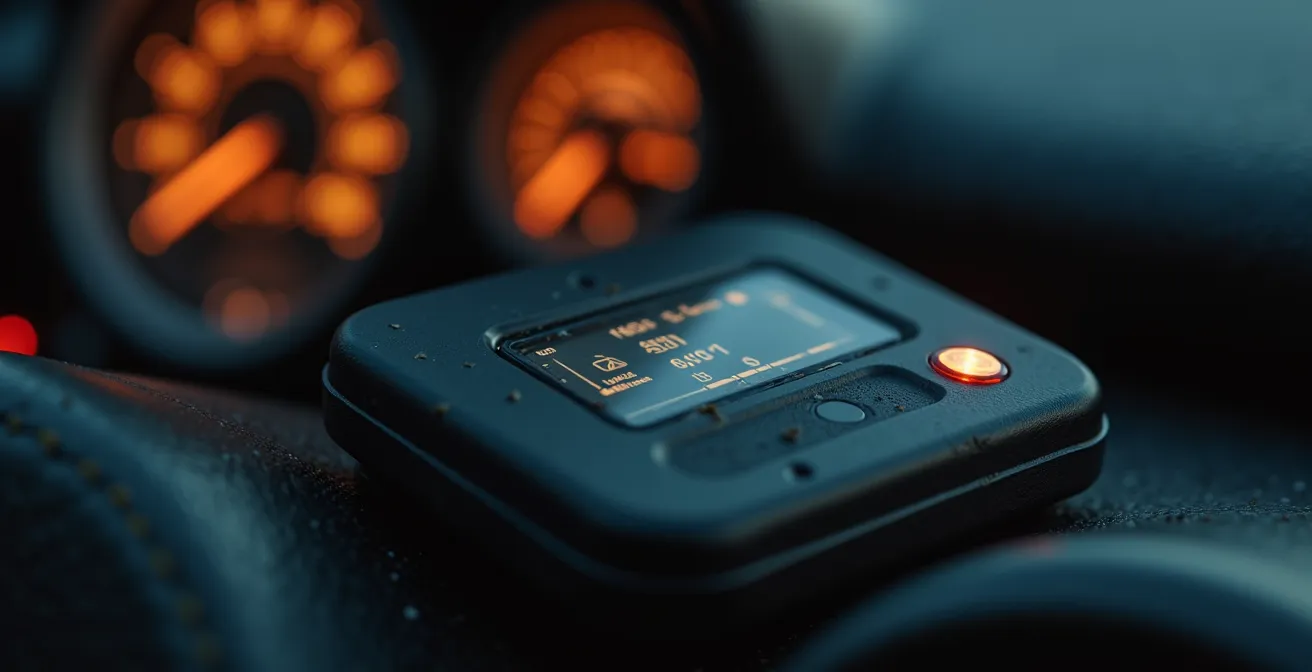
The return on investment becomes even clearer when compared to traditional, passive anti-theft devices. While a steering lock or a car alarm can be a deterrent, they do little to aid in recovery once a theft has occurred. An active GPS tracker, however, transforms your car from a passive target into a trackable asset, dramatically increasing the odds of a swift recovery and minimizing potential damage.
This table, based on data from an analysis by specialists in GPS tracking discounts, illustrates the compelling financial case for choosing an active tracker over passive deterrents.
| Device Type | Annual Cost | Average Insurance Discount | Recovery Rate | ROI Period |
|---|---|---|---|---|
| GPS Tracker (Active) | $200-300 | 15% | 96% | 12-18 months |
| Car Alarm (Passive) | $150-200 | 5% | 46% | 24-36 months |
| Steering Lock | $50-100 | 3% | 35% | 36+ months |
Parking Insurance: Do You Need Fire & Theft for a Car That Never Moves?
Absolutely. In fact, a stored or non-operational vehicle is the quintessential use case for Fire & Theft coverage. When a car is laid-up for a restoration project, stored for the winter, or simply kept as part of a collection and rarely driven, its risk profile changes dramatically. The “dynamic risks” associated with being on the road—collisions, fender-benders, liability incidents—evaporate completely. What remains are the “static risks”: the threat of a garage fire, a break-in, vandalism, or outright theft from its storage location.
This is where F&T coverage shines as the most efficient form of protection. Paying for a comprehensive policy that includes collision coverage for a vehicle that will not move is financially illogical. You are paying to mitigate a risk that is effectively zero. By switching to F&T, you align your premium directly with the real-world threats your stationary vehicle faces. For owners of these vehicles, F&T isn’t just an option; it’s the most logical and financially sound strategy for asset fortification.
Laid-Up Coverage for Stored Classic Cars
As experts at Heritage Car Insurance note, for classic cars that are off the road or in storage, “laid-up cover offers protection without road use.” Their guidance confirms that even if your car is off the road, you still need cover for fire, theft, or accidental damage. A dedicated laid-up policy, which is fundamentally a Fire & Theft policy, is designed to protect your investment while it’s in storage, ensuring that its value is secure even when it’s not being used.
The financial incentive is substantial. Because the insurer is no longer exposed to collision or liability claims, the cost of coverage plummets. It’s not uncommon for classic car insurance premiums to be up to 40% lower for vehicles with limited or no road use. This saving makes F&T the perfect “parking insurance,” providing essential catastrophic protection at a price that reflects the vehicle’s reduced risk profile.
The Depreciation Dispute That Occurs When a Stolen Car is Never Recovered
This is the nightmare scenario for any classic car owner: your vehicle is stolen and never seen again. The initial shock is quickly followed by a daunting question: how much will the insurance company pay? For owners with standard auto insurance, the answer can be devastating. A standard policy typically pays out the “Actual Cash Value” (ACV), which is the car’s replacement cost minus depreciation. For a 15-year-old car, this calculated value might be a fraction of its true market worth as a desirable semi-classic.
This is the single most important reason why “Agreed Value” coverage is non-negotiable for any semi-classic or classic car. As Progressive Insurance clearly states, “With agreed value coverage, you’re guaranteed coverage for the agreed-upon value of your car.” Before the policy begins, you and the insurer agree on a specific value for your vehicle, based on appraisals, restoration records, and market data. If the car is stolen and unrecoverable, that agreed-upon amount is what you receive, period. There are no last-minute arguments over depreciation.
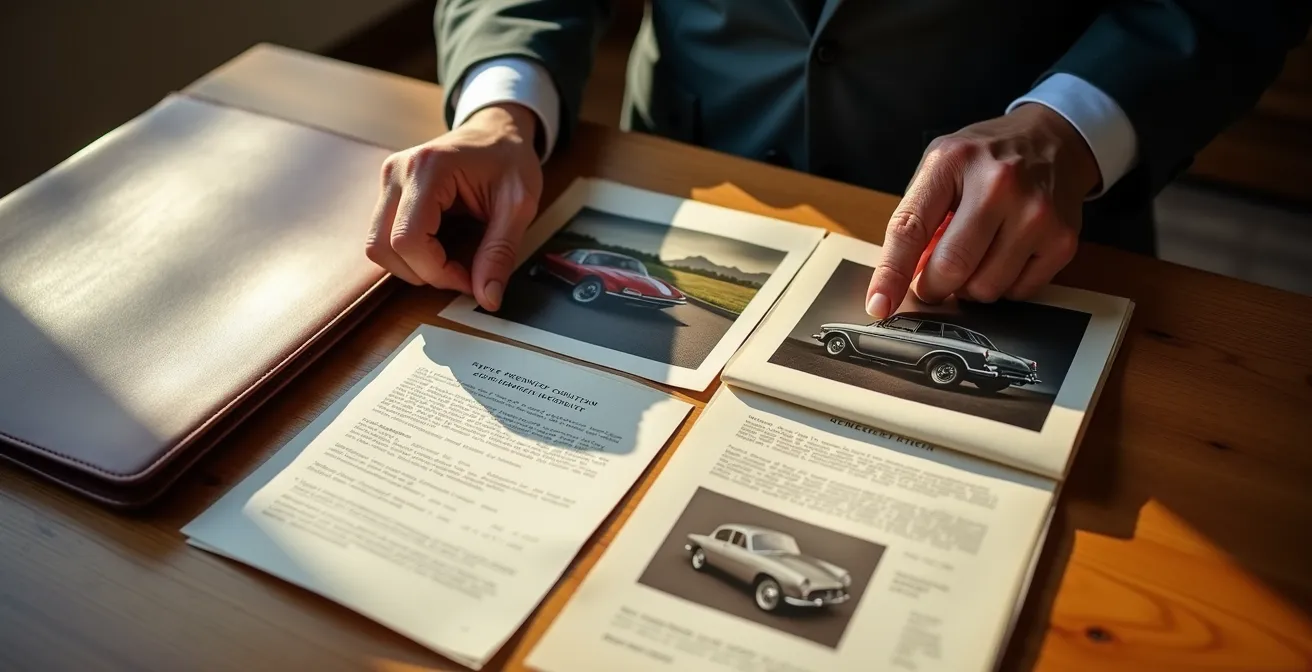
Securing an “Agreed Value” policy requires you to do your homework. You must prove the car’s worth to the insurer. This means building a comprehensive “evidence locker” for your vehicle that meticulously documents its value. This documentation is your best defense against any potential payout disputes and is the foundation of a strong Agreed Value policy. An undocumented classic is just an old car to an adjuster; a documented one is a proven asset.
Checklist: Building Your Pre-Loss Evidence Locker
- Obtain a professional appraisal from a certified classic car appraiser, ideally updated every two years.
- Create comprehensive photo documentation, including all exterior angles, the engine bay, the entire interior, and the undercarriage.
- Organize all maintenance and restoration receipts chronologically in a dedicated binder or digital folder.
- Compile all historical documentation you possess, such as original purchase papers, window stickers, show awards, and records of provenance.
- Research and save recent comparable sales data for your car’s specific year, model, and condition from auctions or reputable classified listings.
When to Downgrade from All-Risk to Fire & Theft: The 10-Year Rule?
The “10-Year Rule” is a common but overly simplistic guideline suggesting that any car older than ten years should have its comprehensive coverage dropped. For a daily driver that depreciates predictably, this can be a reasonable rule of thumb. However, for a semi-classic car, this logic is deeply flawed. The value of these vehicles doesn’t follow a straight line down; it can plateau, or even begin to appreciate, making the decision to switch coverage far more nuanced.
The right time to switch is not based on a simple age milestone, but on a careful analysis of the Value-to-Premium Ratio. The core question is: is the amount you’re paying for collision coverage a reasonable cost to protect the car’s current market value? If the annual cost of comprehensive coverage is a significant percentage (e.g., 20% or more) of the car’s total value, it may no longer be financially sensible. In such cases, you are essentially pre-paying for a total loss over a short number of years. Self-insuring for the collision risk and protecting only against catastrophic fire and theft becomes the more logical financial move.
The following decision matrix, based on industry data, provides a framework for this calculus. It helps visualize the point at which the annual savings from switching to F&T create a substantial self-insurance fund, making the downgrade a calculated financial decision, as noted in a Capital One guide on value-based insurance.
| Car Value | Annual Full Coverage | Annual F&T Only | Annual Savings | Self-Insurance Fund (3 years) | Recommendation |
|---|---|---|---|---|---|
| $5,000 | $1,200 | $400 | $800 | $2,400 | Switch to F&T |
| $10,000 | $1,500 | $500 | $1,000 | $3,000 | Consider F&T |
| $20,000 | $2,000 | $600 | $1,400 | $4,200 | Keep Full Coverage |
Furthermore, a major restoration can completely invert this logic. A car that was a candidate for F&T pre-restoration might require an upgrade back to full coverage post-restoration to protect the new, much higher investment.
The Restoration Investment Protection Strategy
As State Farm’s classic car experts advise, “If you’ve recently restored your car, an updated appraisal can reflect that investment.” Many owners who initially insured their project cars with minimal coverage find themselves needing to upgrade to Fire & Theft or even comprehensive after investing thousands in restoration work. The car’s value is no longer just its base model worth, but includes the significant capital and labor invested, demanding a higher level of protection.
Home vs. Storage Unit: Where Does Your Anti-Theft Coverage End?
An owner’s responsibility for asset protection doesn’t end at the car door; it extends to the environment where the car is stored. Insurers assess risk based on location, and where you park your semi-classic has a direct impact on your Fire & Theft premium. A vehicle stored in a secure, climate-controlled professional facility is seen as a much lower risk than one parked on the street or even in a shared apartment complex garage. This difference in perceived risk is reflected directly in your rates.
It’s also critical to understand the boundaries of your policy. Your auto policy’s Fire & Theft coverage is designed to protect the vehicle itself and its attached parts. It does not cover personal items left inside the car, such as tools, luggage, or memorabilia. Those items are typically covered under a separate Homeowner’s or Renter’s insurance policy. A common and costly mistake is assuming a car break-in is fully covered by the auto policy, only to find the valuable contents are not.
Similarly, when your car is at a mechanic’s shop for service, the primary insurance responsibility falls on the shop’s “Garagekeepers Liability” policy. However, your own F&T policy acts as a crucial secondary layer of protection. If the shop’s insurance is insufficient, non-existent, or they dispute liability, your policy can step in to cover the loss. Choosing a reputable shop with proper insurance is your first line of defense, but your own policy is your ultimate safety net. For collectors with multiple vehicles, bundling them on one policy can also yield significant savings, with some insurers offering a 25% discount for insuring 5 or more specialist cars on a single policy.
How to Determine the Exact Moment Your Car is Too Old for Full Coverage?
The question is framed incorrectly. For a semi-classic or appreciating asset, the car is never “too old” for full coverage; it may simply become too valuable or unique for a standard “Actual Cash Value” policy. The real transition point is not about age, but about when a car stops depreciating and begins to be valued for its rarity, condition, and provenance. At this moment, the conversation must shift from standard insurance to specialized, “Agreed Value” coverage.
As explained by American Family Insurance, “Agreed value is a type of coverage where you and your insurance company agree upon the value of your vehicle when you take out the policy.” This is the mechanism that allows for proper insurance of a vehicle whose value is disconnected from its age. This is the insurance paradox that distinguishes a classic from just an old car.
The concept is best illustrated with a simple comparison. A 25-year-old daily driver, like a Honda Accord, follows a predictable depreciation curve. Its value is minimal, and carrying full comprehensive coverage is likely not cost-effective. However, a 25-year-old performance car, like a Porsche 911, has likely bottomed out in depreciation and may be actively appreciating in value. Dropping coverage on the appreciating asset would be a catastrophic financial error.
The 1998 Honda vs. 1998 Porsche Insurance Paradox
As experts in classic car valuations note, classic cars and restomods “do not follow predictable depreciation curves.” Their value is driven by market demand, condition, and history, not by a standard “book value.” A 1998 Honda Accord is an old car; its owner might rightly choose basic liability coverage. A 1998 Porsche 911, however, is a desirable modern classic. Its owner would be wise to secure a full “Agreed Value” policy, possibly including comprehensive coverage, to protect an asset that could be worth more now than it was ten years ago.
Therefore, the “exact moment” is not a date on a calendar. It is the moment your vehicle’s value is determined more by the market of enthusiasts than by an actuary’s depreciation table. At that point, your focus must shift to finding an insurer who understands and offers Agreed Value coverage, whether that’s within a Fire & Theft or a full comprehensive policy.
Key Takeaways
- Fire & Theft coverage is a strategic choice for semi-classics, perfectly aligning cost with the most probable catastrophic risks for a stored vehicle.
- An “Agreed Value” policy is non-negotiable. It is the only way to ensure you are compensated for your car’s true market worth in the event of a total loss.
- Actively reinvest premium savings into security upgrades like a GPS tracker; this creates a virtuous cycle of lower risk, lower premiums, and better protection.
How Installing a GPS Tracker Can Pay for Your Fire & Theft Upgrade?
Beyond the direct financial ROI, integrating a GPS tracker is a strategic decision that fundamentally alters your car’s risk profile and enhances your peace of mind. The financial benefit is the hook, but the true value lies in the operational and psychological advantages. A high recovery rate isn’t just a statistic; it’s the difference between a temporary inconvenience and a permanent, heartbreaking loss of an irreplaceable asset.
When selecting a tracker, it’s crucial to choose a model that is approved by insurance underwriters. These are typically active, monitored units that communicate with a central service. When you inform your insurer you’ve installed one, be prepared to provide the make, model, and subscription details. The discount is not automatic; it’s a specific endorsement you must request and prove you qualify for. This proactive communication is key to maximizing the “premium arbitrage” effect.
Consider the non-financial ROI. The ability to set geofences that alert you if your car moves without authorization, the peace of mind knowing its location is always accessible, and the feeling of control over your asset’s security are invaluable. For a semi-classic owner, the car is more than metal; it’s a repository of time, effort, and memories. A GPS tracker acts as a digital guardian for that investment. It’s the practical implementation of your decision to move to a smarter, more focused protection strategy—one that actively defends against specific threats rather than passively paying for all-risk coverage.
By shifting your perspective from a passive premium-payer to an active risk manager, you can build a more resilient and cost-effective protection plan for your cherished vehicle. The next logical step is to gather your vehicle’s documentation and speak with a specialist insurer to get a personalized quote based on an “Agreed Value” and this strategic F&T approach.
Frequently Asked Questions about Classic Car Fire & Theft Coverage
Does my Fire & Theft auto policy cover personal items stolen from my classic car?
No, your auto policy’s Fire & Theft coverage only protects the vehicle itself. Personal items inside are typically covered by your Homeowner’s or Renter’s insurance.
Am I covered if my car is damaged at a mechanic’s shop?
The shop’s Garagekeepers Liability insurance is primary, but your Fire & Theft coverage acts as secondary protection if the shop’s insurance is inadequate or absent.
Does storage location affect my Fire & Theft premium?
Yes, insurers assess risk differently for on-street parking, private garages, and professional storage facilities, with secure storage typically resulting in lower premiums.