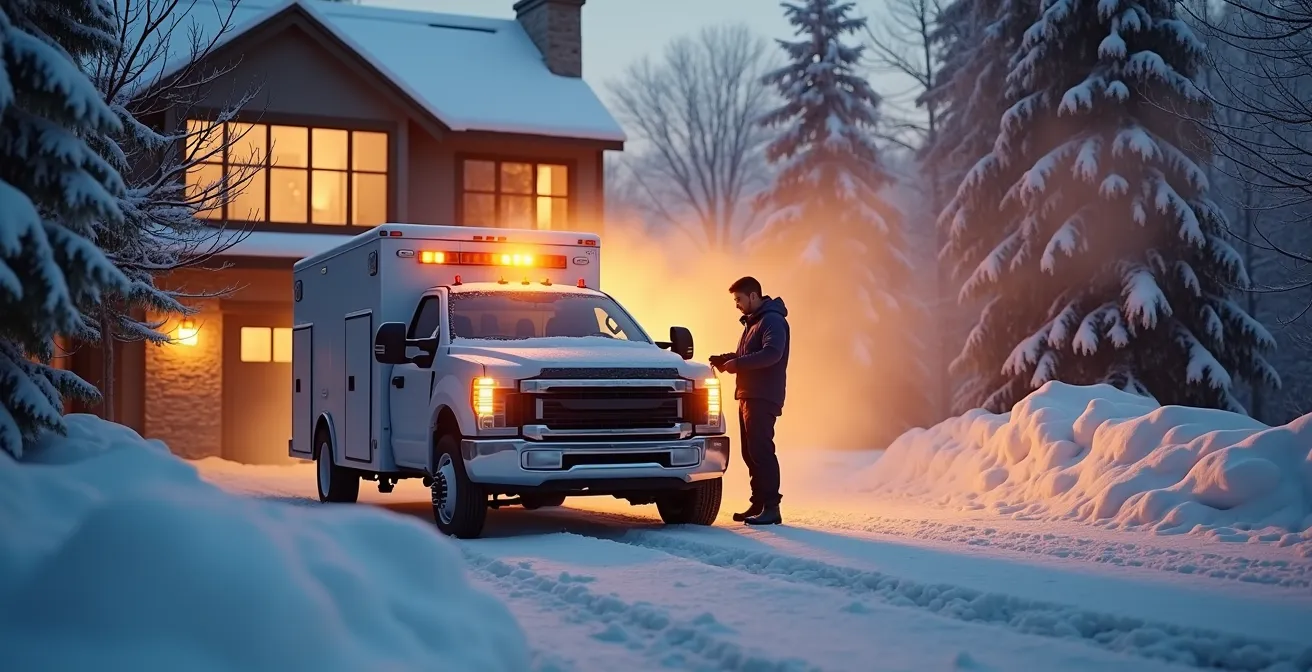
The hard truth is your standard roadside assistance is likely useless for a breakdown in your own driveway, creating a logistical illusion of safety.
- Most policies have a “home exclusion” or minimum distance rule, leaving you stranded where you feel safest.
- Zero-mile coverage specifically closes this gap, activating service from the moment you turn the key at home.
Recommendation: Before winter hits, call your insurer and ask one simple question: “If my car battery dies in my driveway, are you sending a truck?” If the answer isn’t a clear “yes,” it’s time to upgrade.
There’s no sound quite as defeating as the weak click-click-click of a dead battery on a frosty winter morning. You’re home, you’re safe, but you’re not going anywhere. Your first instinct might be to pull out your insurance card and call for roadside assistance. It’s what you pay for, right? Many drivers assume their coverage is a universal safety net, ready to catch them whether they’re on a highway or in their own driveway. They believe having a plan with a big name is all that matters.
But here’s the cold reality I see every day from the dispatcher’s seat: that safety net often has a giant hole right where your home is. The common advice to “get roadside assistance” is good, but it misses the most critical detail. The key isn’t just *having* coverage; it’s understanding the fine print that dictates *where* it actually works. What if the most valuable part of your policy isn’t the tow truck, but a single, often-overlooked clause about your starting location?
This article will pull back the curtain on the logistical illusion of standard roadside plans. We will explore why many policies fail you at home, dissect the crucial differences between providers, and reveal the hidden costs and traps that turn a “free” service call into an expensive headache. Forget the generic advice; we’re diving into the specifics that will ensure you’re never truly stuck, especially when you’re just feet from your front door.
To navigate the complexities of roadside coverage, it’s essential to understand how different services stack up and where the hidden pitfalls lie. This guide breaks down everything from at-home breakdowns to rental car coverage, providing the clarity you need to make an informed choice.
Summary: Your Guide to Never Being Stranded at Home Again
- Why Standard Roadside Assistance Won’t Help You if You Break Down at Home?
- Auto Insurer Assistance vs. AAA/CAA: Which Offers Faster Towing Times?
- Battery Dead in Driveway: Is It Worth Calling Insurance or Just Paying Cash?
- The Towing Limit Trap That Leaves You paying $100 for the Last 5 Miles?
- How to Extend Your Roadside Coverage to Rental Cars During Vacation?
- Big Brand vs. Digital-Only Insurer: Which Offers Better Claims Service?
- The Rental Car Oversight That Leaves You Stranded for 2 Weeks During Repairs?
- Auto Insurer Assistance vs. AAA/CAA: Which Offers Faster Towing Times?
Why Standard Roadside Assistance Won’t Help You if You Break Down at Home?
This is the most common and frustrating blind spot in many insurance policies. You pay your premium faithfully, assuming you’re covered, only to discover you’re in what we call the “Driveway Dead Zone.” Many standard roadside assistance plans, particularly those bundled with auto insurance, have a “call-out distance” or “home exclusion” clause. This fine print states that the service will only activate if you are a certain distance away from your registered home address—often as little as a quarter-mile, but that’s a quarter-mile too far when you’re in the driveway. The logic is that at-home issues are the owner’s responsibility. With a reported 22% increase in winter car breakdowns over the last five years, this is a gap you cannot afford to ignore.
This is where zero-mile roadside assistance becomes the hero. It’s a specific feature that eliminates the distance requirement. Some providers, like Progressive, make this a key part of their offer. They uniquely provide roadside assistance for non-accident breakdowns whether you’re on the highway or in your own driveway. Their policy, for example, might arrange to tow your vehicle to a qualified repair shop within a 15-mile radius, even if it starts from your home address. This single feature transforms your policy from a ‘maybe’ to a reliable tool for the most common breakdown scenarios.
Without zero-mile coverage, your roadside assistance plan is essentially a lottery ticket that only pays out when you’re away from home, ignoring the place where your car spends most of its time.
Auto Insurer Assistance vs. AAA/CAA: Which Offers Faster Towing Times?
When you’re stuck, every minute feels like an hour. The promise of “fast” service is a key selling point, but the reality on the ground depends entirely on the provider’s business model. The fundamental difference lies in their service network: is it a dedicated fleet or a patchwork of third-party contractors? This is where established motor clubs like AAA/CAA often have a distinct advantage. They operate or have deep partnerships with their own professional service fleets, ensuring a certain standard of training, equipment, and availability across a national network.
In contrast, most auto insurers—both traditional and digital-first—act as dispatchers, outsourcing the actual service to local, independent tow companies. While this can work well in dense urban areas with many contractors, it can lead to significant delays in rural locations or during peak demand, like a city-wide snowstorm. The quality of service can also vary wildly from one contractor to the next. The following table breaks down the typical differences in their operational models.
As this comparison of roadside assistance providers highlights, the method of contact and the nature of the service network are the two biggest factors influencing how long you’ll be waiting.
| Provider | Response Method | Average Wait Time | Service Network |
|---|---|---|---|
| AAA | Mobile app or phone | Less than 3.5 minutes to contact, less than 1 hour arrival | Professional service fleet with 24/7 national coverage |
| Digital-First Insurers | App with GPS tracking | Varies by location | Third-party contractors |
| Traditional Insurers | Phone call | Varies significantly | Third-party service providers |
Ultimately, while an insurer’s plan might be cheaper or more convenient to bundle, a dedicated motor club is often the better bet for those who prioritize the fastest possible response time and consistent service quality.
Battery Dead in Driveway: Is It Worth Calling Insurance or Just Paying Cash?
Here’s a situation where you need to think like an economist. You have a dead battery. You could use your “free” roadside assistance, but you know it might take an hour or more for the truck to arrive. Or, you could pay out of pocket for a local service. This is what I call “Response Time Economics.” Your time has value. If you’re a freelancer who bills at $100/hour, a two-hour wait for a “free” jump-start has actually cost you $200 in lost productivity. Suddenly, paying cash for an immediate solution looks a lot more attractive. Without coverage, hiring a tow truck for a simple jump-start can cost around $75.
Furthermore, you have to consider “Service Call Burn.” Many basic roadside plans limit you to a certain number of service calls per year, typically three to five. Is a simple jump-start—a problem that can often be solved in minutes—really worth using up one of your precious calls? You might need that call later in the year for a more serious issue, like a major mechanical failure that requires a long-distance tow. Using a limited resource on a minor inconvenience is a poor strategic choice, especially when there are cost-effective alternatives.
Your Action Plan: Dead Battery Cost-Benefit Analysis
- Assess the cash option: Remember that professional jump-start services cost around $75 without coverage. Is your time worth more than that?
- Calculate your time’s value: If you earn $100/hour and wait 2 hours for a ‘free’ service, that’s $200 in lost productivity you’ve just spent.
- Invest in self-reliance: Consider a portable jump starter. A reliable unit can be purchased for under $70 and stored in your trunk, giving you immediate power.
- Maintain your tool: A portable jump starter isn’t a “set it and forget it” device. Recharge your unit every six months to ensure it’s ready when you need it.
- Evaluate the service call: Before you call, ask yourself: is using one of my limited annual service calls truly worth it for this simple jump-start?
Ultimately, for a simple dead battery at home, the smartest and often cheapest long-term solution is self-reliance—a good quality portable jump starter pays for itself the very first time you use it.
The Towing Limit Trap That Leaves You paying $100 for the Last 5 Miles?
This is one of the most common and infuriating “gotchas” in roadside assistance: the “Radius Trap.” Your policy proudly states it includes towing, but it’s almost never unlimited. Most plans, whether from an insurer or a motor club, cover towing up to a specific distance—typically 5, 15, or maybe 100 miles for premium plans. The problem is, you’re on the hook for every single mile beyond that limit, and the per-mile overage rate charged by towing companies can be steep.
Let’s look at a real-world example. A provider like Progressive might arrange to tow your vehicle anywhere within a 15-mile radius. That sounds generous. However, imagine your trusted mechanic is 20 miles away. The policy will cover the first 15 miles, but you’re responsible for the final 5. If the overage rate is $20 per mile, you’ve just received a surprise $100 bill for a service you thought was “covered.” The policy might also state it will tow to the *nearest qualified repair shop*. If you insist on going to your preferred shop instead of the closest one, you could be responsible for the entire extra mileage cost.
Before you ever let a tow truck hook up your car, you must ask two questions: “Where are you authorized to tow my car under my plan?” and “If I want to go somewhere else, what is the per-mile cost for the overage?” Getting this information upfront prevents a frustrating and expensive surprise when the invoice arrives. Without this diligence, you can easily fall into the Radius Trap.
The key takeaway is that “towing included” is not a blank check. It’s a strictly defined benefit, and understanding its limits is your best defense against unexpected costs.
How to Extend Your Roadside Coverage to Rental Cars During Vacation?
You’ve meticulously planned your vacation, but have you planned for a breakdown in your rental car? The assumption that your personal auto insurance or roadside plan automatically extends to a rental can be a risky one. While it sometimes does, coverage can be secondary, limited, or non-existent, especially when traveling internationally. The last thing you want is to be stranded on a scenic mountain road, arguing with a rental company over who is responsible for a flat tire.
Fortunately, you have several layers of potential protection, and the key is to know which one is primary. Your personal auto policy might extend its roadside assistance if you have it, but you must verify this. Premium credit cards often include secondary rental car insurance and some roadside benefits, but “secondary” means you have to go through your primary insurance first. The rental company will always offer their own (often expensive) daily coverage, which is primary but adds up quickly. Finally, a motor club membership like AAA is tied to the member, not the vehicle, so it often covers you in any car you’re driving, including rentals.

This table outlines how the different sources of coverage typically apply to rental vehicles, but you must always check the specific terms of your own policies before you travel.
| Coverage Source | Rental Car Coverage | Primary/Secondary | International Coverage |
|---|---|---|---|
| Personal Auto Policy | Often extends to rentals if vehicle is insured by same company | Primary | Usually excluded |
| Premium Credit Cards | Secondary coverage included | Secondary | Varies by card |
| Rental Company Add-on | Full coverage | Primary | Country-specific |
| AAA Membership | Covers member in any vehicle in the US | Primary | Limited international |
The best strategy is a proactive one: make a few calls before your trip to confirm your coverage. A few minutes of research can save you hours of stress and hundreds of dollars on the road.
Big Brand vs. Digital-Only Insurer: Which Offers Better Claims Service?
When you need help, the quality of the service matters just as much as the speed. This is where the difference between a big, established brand and a newer, digital-only insurer becomes stark. Big brands like AAA have spent decades building a reputation for reliability. Their business is roadside assistance, and their customer satisfaction often reflects that singular focus. As the AAA U.S. Market Track survey for 2024 notes:
AAA beats all major competitors in overall customer satisfaction and is the most highly recommended among U.S. motor clubs
– AAA U.S. Market Track, 2024 National Survey
However, digital-only insurers have a different kind of advantage: technology. They build their systems from the ground up around a mobile app, streamlining the process of requesting help. Instead of navigating a phone tree, you can request service with a few taps, and GPS tracking shows you exactly where your tow truck is in real-time. This can dramatically improve the experience, especially for simple issues. For instance, a UK study found that drivers get help twice as fast by using an app instead of calling. This efficiency is the core promise of the digital-first model.

The choice comes down to your priorities. Do you value the proven, consistent track record and dedicated fleet of a big brand, or do you prefer the speed, transparency, and convenience of a slick, modern app? For a complex issue in a remote area, the big brand’s network might be superior. For a simple dead battery in a city, the digital insurer’s app could have you back on the road faster.
There is no single “best” option; the superior choice depends entirely on the specific breakdown scenario and your personal tolerance for technological versus traditional service interactions.
The Rental Car Oversight That Leaves You Stranded for 2 Weeks During Repairs?
This is a nightmare scenario for any driver: your car breaks down far from home and requires extensive repairs that will take weeks. Your roadside assistance got you to the shop, but now what? You’re stranded. This is where a lesser-known benefit called “Trip Interruption Coverage” comes into play. It’s designed to help cover the costs of lodging, meals, and alternative transportation while you wait for your car to be fixed. However, like all insurance, it’s riddled with limits.
Most policies have a strict cap. For example, a common policy might state that trip interruption typically covers up to a $500 maximum with daily limits of $100 for lodging, $50 for transportation, and $50 for food. While helpful for a one or two-night delay, this is woefully inadequate if your car is out of commission for a week or more due to parts delays. Furthermore, this coverage often only kicks in if you are more than 100 miles from home and after your vehicle has been officially checked in by the repair facility, not from the moment it breaks down. This can create a 24-48 hour gap where you are on your own.
To manage this risk, you must be your own advocate. Immediately start documenting all your expenses. If your disabled car is blocking others, arrange for alternative transport right away. Check if your plan has a premium tier, which might offer a higher daily reimbursement. The most crucial step is to understand that the initial tow is just the first step in a long logistical chain. Assuming your insurance will seamlessly handle everything from that point on is a recipe for being stranded and out-of-pocket.
The hard lesson is that roadside assistance is a first-response service, not a long-term logistics solution. You must have a contingency plan for what happens after the tow.
Key Takeaways
- Standard roadside assistance often has a “home exclusion” clause, making it useless in your own driveway.
- “Zero-mile” coverage is the specific feature that ensures you get help at home, closing a critical policy gap.
- Weigh the “Response Time Economics”—your time has value, and sometimes paying cash for a quick fix is cheaper than waiting for a “free” service.
Auto Insurer Assistance vs. AAA/CAA: Which Offers Faster Towing Times?
Beyond the business models, the actual on-the-ground experience of waiting for a tow truck is heavily influenced by provider network density. Imagine a map of your city at night. A provider with high network density would look like a grid of evenly spaced, waiting vehicles, ready to be dispatched to the nearest incident. A provider with low density might only have a few trucks covering a vast area. This is the practical difference between a dedicated fleet and an outsourced contractor model.
Dedicated motor clubs like AAA invest heavily in building and maintaining this dense network. Their goal is to have service vehicles strategically positioned to minimize travel time to any potential breakdown location. This is their core business, and their reputation depends on it. Insurers who use third-party contractors are essentially “renting” access to a network that is also serving their competitors, individual cash calls, and police rotations. During a high-demand event like a snowstorm, their ability to secure a truck for you is diluted by all the other calls in the queue.

The image above provides a visual metaphor for this concept. Each light represents a ready service vehicle. A provider with more lights on the map, distributed more evenly, will inherently provide a faster response. When choosing a plan, you’re not just buying a promise; you’re buying access to a physical network. A plan that is a few dollars cheaper might seem like a good deal, until you’re the one waiting in a location where your provider has no “lights” on their map.
Before you commit to a plan, ask about their service model. Do they operate their own fleet or use contractors? Understanding the answer is the best way to predict how long you’ll actually be waiting when you need them most.