
Opting for third-party insurance isn’t just about being cheap; it’s a strategic financial move that fails without a clear understanding of its significant coverage gaps.
- State minimums are dangerously inadequate for modern accident costs, exposing you to personal financial ruin.
- Key protections for your own assets—like passenger injury (in single-car accidents), glass, fire, and theft—are not included but can be strategically added back.
Recommendation: Use the “10% rule.” If your annual premium for full coverage exceeds 10% of your car’s current value, it’s time to switch to a tailored, liability-focused policy.
That hefty car insurance bill arrives every six months, a painful reminder of the cost of owning a vehicle, especially an older one whose value is dropping faster than your premium. The common advice echoes in your mind: “Your car is old, just get the cheapest third-party liability coverage. It’s all you legally need.” It feels like a simple, logical way to slash your fixed costs. But this simplicity is deceptive and dangerous.
Treating third-party insurance as merely the “cheap option” is a financial gamble with catastrophic potential. The real question isn’t *if* you should drop full coverage, but *how* you actively manage the new financial risks you’re taking on. This requires a shift in mindset: you are no longer just a policyholder; you are your own risk manager. The goal is a concept known as risk arbitrage—consciously accepting a calculated risk (like paying for your own fender-bender) in exchange for a significantly lower premium, while still protecting yourself from financial ruin.
This guide moves beyond the simplistic “full vs. liability” debate. We will dissect the real financial exposure of a minimum policy, identify the precise “financial tipping point” where full coverage stops making sense, and reveal how to use strategic unbundling—stripping down your policy and then adding back high-value, low-cost protections. This is how you transform a risky gamble into a smart, calculated financial decision.
To navigate this complex decision, this article breaks down the most critical financial questions you need to answer. From understanding the bankruptcy risk in a multi-car accident to pinpointing the exact moment your car is too old for full coverage, each section provides the clarity needed to build a smarter, leaner, and safer insurance strategy.
Summary: Is Third-Party Only Insurance a Smart Gamble for Your Budget?
- Why Third-Party Coverage Could Bankrupt You in a Multi-Car Pileup?
- How to Determine the Exact Moment Your Car is Too Old for Full Coverage?
- State Minimum vs. Recommended Liability: Why $50,000 is Rarely Enough?
- The Liability Gap That Might Leave Your Injured Passengers Unprotected
- How to Add Glass Coverage to a Third-Party Policy for Under $5/Month?
- Why Your Insurer Must Provide a Lawyer Even If You Might Be At Fault?
- Why Two Neighbors Can Pay $500 Difference for the Same Car Insurance?
- Why Fire and Theft Coverage is the Sweet Spot for Semi-Classic Cars?
Why Third-Party Coverage Could Bankrupt You in a Multi-Car Pileup?
The core promise of third-party liability insurance is simple: if you cause an accident, it pays for the other party’s damages and injuries, up to your policy limits. For a minor fender-bender with a single vehicle, a state-minimum policy might be sufficient. But a multi-car pileup on a highway is a scenario of rapid, exponential financial exposure. You could be deemed at-fault for a chain reaction involving three, four, or more vehicles. Suddenly, you’re not just liable for one bumper; you’re on the hook for multiple vehicles, some of which may be luxury cars with advanced sensors and expensive-to-repair technology.
The costs escalate alarmingly. Modern vehicles are packed with technology that makes repairs far more expensive than in the past. Even a seemingly simple windshield crack can be a major expense, with industry analysis showing an average replacement cost over $1,000 for a windshield that requires sensor recalibration. Now, multiply that by several cars, add in dent repairs, paint, and potential frame damage. Your $25,000 or $50,000 property damage limit can be exhausted almost instantly. Once that limit is breached, the remaining claims come directly out of your pocket. This can lead to wage garnishment, liens on your property, and, in the worst-case scenario, bankruptcy.
This is where understanding your total financial picture is critical. For those with assets to protect (a home, savings, investments), relying on minimum liability is a catastrophic risk. A personal umbrella policy is the crucial backstop. As an example of this protection, a $1 million personal umbrella policy can cost as little as $383 per year for an individual with a home and two cars. This provides an additional layer of liability protection that kicks in after your auto policy limits are exhausted, effectively acting as bankruptcy prevention insurance. It is the single most important consideration for anyone choosing a third-party policy but who has assets they cannot afford to lose.
How to Determine the Exact Moment Your Car is Too Old for Full Coverage?
The advice to “drop full coverage on an old car” is one of the most common yet dangerously vague pieces of financial guidance. “Old” is subjective. Is a five-year-old car with 100,000 miles old? What about a 15-year-old garage-kept classic? The answer isn’t about age or mileage; it’s about a cold, hard calculation. The decision to drop collision and comprehensive coverage hinges on a concept called the financial tipping point: the moment the cost of the insurance outweighs the potential payout you would receive if the car were totaled.
You can find this tipping point with a simple formula known as the “10% rule.” The logic is straightforward: if your annual premium for collision and comprehensive coverage is more than 10% of your car’s current cash value, you are likely overpaying for protection. At this point, you’re better off banking those premium savings into an emergency fund to cover potential repairs yourself. This transforms your decision from a gut feeling into a data-driven financial strategy.
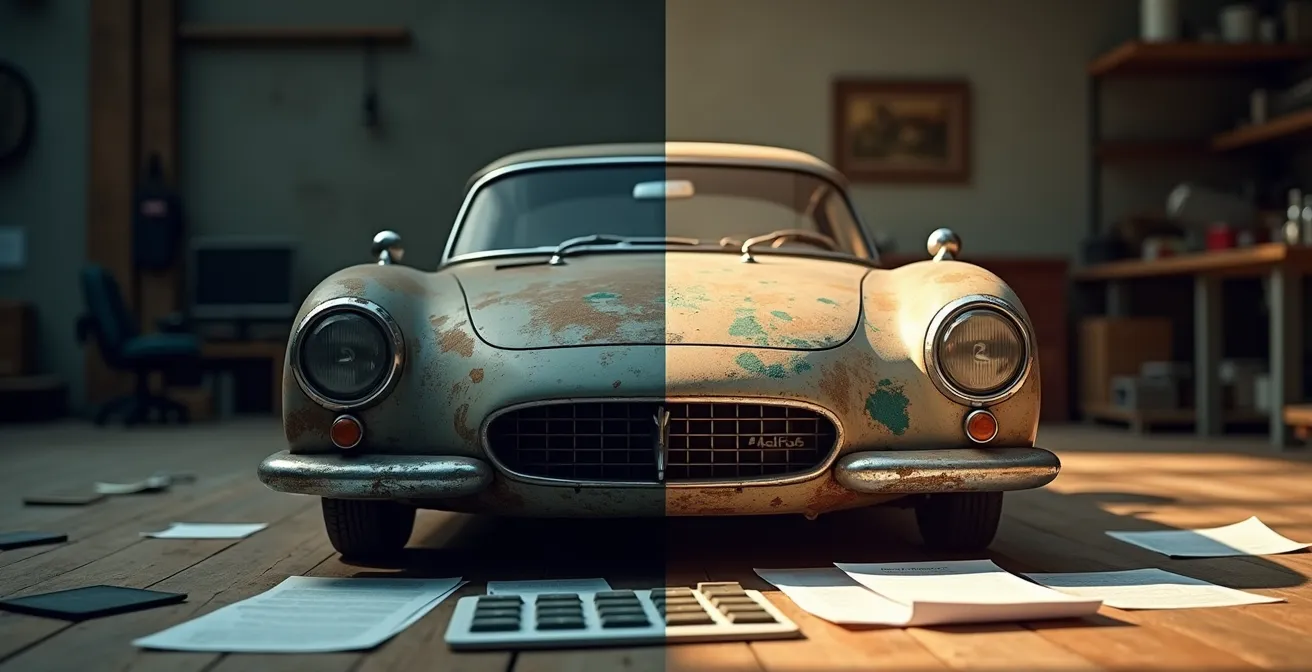
This calculation forces you to confront the reality of your vehicle’s worth. If your car is valued at $4,000, and you’re paying $500 a year for full coverage, you’re paying over 12% of its value annually. In the event of a total loss, your payout (after the deductible) might only be $3,000-$3,500. By switching to liability-only and saving that $500, you are making a conscious decision to self-insure against damage to your own vehicle, a classic example of risk arbitrage. It’s a bet on your own driving, but one based on a clear financial rationale.
Your Action Plan: Finding the Financial Tipping Point
- Check Your Car’s Value: Get its current private party value from a reputable source like Kelley Blue Book (KBB) or Edmunds. Be honest about its condition.
- Calculate the 10% Threshold: Multiply your car’s value by 0.10. This is your critical number.
- Isolate Your Premium: Look at your insurance declaration page and find the specific cost for “Collision” and “Comprehensive” coverage for a full year. Ignore the liability portion.
- Compare and Decide: If your annual collision/comprehensive premium is higher than the 10% threshold you calculated, it is financially rational to consider dropping these coverages.
- Verify Your Emergency Fund: Before making the switch, ensure you have enough cash saved to cover your deductible or minor-to-moderate repairs out of pocket. Without this, you are gambling, not managing risk.
State Minimum vs. Recommended Liability: Why $50,000 is Rarely Enough?
Every state mandates a minimum level of liability insurance to legally operate a vehicle. For many budget-conscious drivers, meeting this minimum and nothing more seems like the finish line. This is a profound financial mistake. State minimums are often decades old and have not kept pace with the soaring costs of medical care and vehicle repairs. A property damage limit of $25,000 might have been adequate in 1995, but today it may not even cover the full replacement cost of a single, moderately-priced new car.
The reality of modern vehicle repair costs demonstrates this gap starkly. Damage that appears cosmetic can hide a web of expensive-to-replace sensors and electronics. A simple bumper replacement is no longer a few hundred dollars; it can easily run into the thousands once labor and sensor recalibration are factored in. The following table highlights how quickly costs for common repairs can escalate, far exceeding typical minimum liability limits.
| Repair Type | Cost Range | With Sensors/Tech |
|---|---|---|
| Bumper Replacement | $500-$1,500 | $1,500-$2,500 |
| Minor Dent Repair | $200-$600 | $600-$1,000 |
| Light Scratches | $100-$300 | $300-$600 |
However, the most significant risk is not property damage, but bodily injury liability. Medical costs, lost wages, and pain and suffering judgments can quickly reach astronomical figures. If you cause an accident that results in serious or permanent injury to another person, your state minimum coverage will be a drop in the bucket. The financial consequences are severe. A large judgment against you could lead to the seizure of your assets and garnishment of your future wages for years. According to insurance industry data, this is not a remote possibility; Trusted Choice reports that 13% of personal injury liability awards exceed $1 million. Opting for higher limits, such as 100/300/100 ($100k per person, $300k per accident, $100k property damage), is a far more prudent baseline for anyone with any income or assets to protect.
The Liability Gap That Might Leave Your Injured Passengers Unprotected
One of the most misunderstood aspects of third-party liability insurance is who it actually protects. It is designed to cover your liability to *third parties*—that is, other people and their property. It is not designed to cover you or, in many common scenarios, your own passengers. This creates a dangerous coverage gap that can have devastating consequences for your friends and family riding with you.
Consider a single-vehicle accident. You’re driving with a friend, swerve to avoid a deer, and hit a tree. Your friend is injured and has significant medical bills. In this situation, your standard third-party liability insurance pays them exactly zero dollars. Because there was no “third party” you were negligent against (you can’t sue a deer or a tree), the liability portion of your policy is not triggered for your passenger’s injuries. This is a shocking revelation for most drivers who assume their insurance “covers” anyone in their car.
A real-world analysis from Michigan Auto Law highlights this exact scenario, explaining that in a single-car crash, only separate, optional coverages would help an injured passenger. This is why it’s critical to understand two key add-ons: Medical Payments (MedPay) or Personal Injury Protection (PIP), depending on your state. These coverages are first-party, meaning they pay for medical expenses for you and your passengers regardless of who is at fault. They are typically inexpensive to add to a policy and are the only way to close this specific, dangerous liability gap. Choosing a third-party policy without at least a small amount of MedPay or PIP is an explicit decision to leave your own passengers financially unprotected in a single-car accident.
How to Add Glass Coverage to a Third-Party Policy for Under $5/Month?
When stripping down to a liability-only policy, drivers often assume they must forgo all “creature comfort” coverages. Glass coverage is usually the first to go. This is a classic example of being “penny wise and pound foolish.” A small rock kicked up on the highway can result in a bill that is disproportionately high compared to the cost of insuring against it. While a minor chip repair might be manageable, a full windshield replacement on a modern car is a significant expense.
The reason for the high cost lies in the advanced driver-assistance systems (ADAS) embedded in and around the glass. Cameras and sensors for lane-keeping assist, automatic braking, and adaptive cruise control are often mounted to the windshield. According to RSM research, the average windshield replacement now costs over $1,000 because it requires not just new glass, but also a precise and time-consuming recalibration of these safety systems. Paying this out-of-pocket can completely negate the savings you’ve achieved by switching to a third-party policy.
The smart financial move is strategic unbundling. Instead of accepting an all-or-nothing approach, you can add a specific, low-cost endorsement for glass coverage to your liability policy. Many insurers offer a standalone “full glass coverage” rider, often with a zero-dollar deductible, for just a few dollars a month. This is one of the highest-value add-ons available. To secure it, you must be proactive and specific when speaking with your insurance agent or representative. You cannot simply assume it’s included.
To request this, follow these direct steps:
- Call your insurance provider directly and speak to an agent.
- Use the exact terminology: ask for a “standalone full glass coverage endorsement with a zero-dollar deductible.”
- Confirm that the coverage includes both repair and full replacement.
- Explicitly verify that the cost of ADAS recalibration is included in the coverage.
- Request written confirmation of the endorsement and its exact monthly cost before agreeing.
Why Your Insurer Must Provide a Lawyer Even If You Might Be At Fault?
When you buy third-party liability insurance, you are purchasing more than just a pool of money to pay for damages. You are also buying a powerful, and often overlooked, legal shield. Buried in the fine print of every liability policy is a clause known as the “Duty to Defend.” This clause obligates your insurance company to provide legal defense and pay for all associated court costs for any claim or lawsuit filed against you that is potentially covered by your policy.
This is a massive hidden benefit. The duty to defend applies even if the lawsuit against you is frivolous, fraudulent, or groundless. It also applies even if you are partially or entirely at fault. The insurer’s obligation is to defend you until the case is settled or a judgment is rendered, regardless of the eventual outcome. This is a critical protection, as the cost of a legal defense alone can be financially crippling.
The ‘Duty to Defend’ is the hidden second part of your liability coverage. You’re not just buying money to pay claims; you’re buying a legal team on retainer.
– Insurance Law Expert, Michigan Auto Law Analysis
The financial value of this benefit cannot be overstated. As legal experts estimate, the cost for a private defense attorney can range from $300 to $500 per hour. A lawsuit stemming from a car accident can easily rack up tens of thousands of dollars in legal fees before it even gets to court. With a liability policy, your insurer handles hiring the attorneys and paying all these bills. This protection alone can be worth more than years of premiums. Understanding this benefit reframes the value proposition of liability insurance: it’s not just coverage, it’s prepaid access to a legal defense team.
Why Two Neighbors Can Pay $500 Difference for the Same Car Insurance?
It’s one of the most frustrating puzzles in personal finance: you and your neighbor have similar cars and clean driving records, yet your insurance premiums are wildly different. This disparity highlights a fundamental truth of insurance pricing: it’s based on vast pools of data where your individual behavior is only one small factor. Insurers are masters of risk segmentation, and they use dozens of data points to place you into a specific “risk territory.”
Your location is one of the most powerful factors. Insurance rates can vary not just by state or city, but by ZIP code and even by street. As one analysis points out, living on opposite sides of a major road can place you in two different risk territories. One side may have statistically higher rates of theft, vandalism, or accidents, leading to higher premiums for everyone residing there, regardless of their personal driving history. The insurer isn’t pricing you; they are pricing the aggregated risk of your immediate environment.
Beyond location, a host of non-driving factors come into play, creating a complex pricing matrix. These can include:
- Credit Score: In most states, insurers use a credit-based insurance score as a strong predictor of future claims. A lower score often results in a higher premium.
- Profession and Education Level: Certain professions are statistically correlated with lower-risk driving behavior, and this can be factored into your rate.
- Vehicle Type: It’s not just the value of your car, but its specific claims history. A model popular with street racers or one that is a high target for theft will cost more to insure.
- Annual Mileage: The less you drive, the less risk you represent. Low-mileage discounts can be significant.
This is why shopping around is not just a suggestion; it’s a necessity. Each insurance company has its own proprietary algorithm and weighs these factors differently. One company might heavily penalize your ZIP code, while another might give more weight to your excellent credit score, resulting in a much better rate.
Key Takeaways
- Third-party coverage is an active risk management strategy, not a passive cost-saving measure.
- Your primary financial exposure comes from liability claims (injury and property damage), which can easily exceed state minimums.
- The “10% rule” is your best guide to determine the financial tipping point for dropping comprehensive and collision coverage.
Why Fire and Theft Coverage is the Sweet Spot for Semi-Classic Cars?
Owners of semi-classic cars—vehicles typically 15-25 years old, like a first-generation Mazda Miata or a 90s-era Ford Mustang—face a unique insurance dilemma. The car may not be valuable enough to warrant expensive full coverage, especially collision, but it’s too cherished and potentially appreciating to leave completely unprotected with just a basic liability policy. This is where a tailored approach provides the perfect solution: a policy that combines third-party liability with a Fire and Theft endorsement.
This combination perfectly aligns the coverage with the real-world risks these vehicles face. A semi-classic is often a weekend car, not a daily driver. The risk of a collision is relatively low, but the risk of it being stolen from a garage or damaged in a fire is ever-present. Standard collision coverage is priced for daily-use vehicles and often doesn’t make financial sense. Fire and theft coverage, however, is an inexpensive add-on that protects the owner’s investment against two of the most likely total-loss scenarios for a garaged vehicle.
This “Liability + Fire & Theft” combination occupies the “just right” middle ground between insufficient protection and overpriced coverage. It’s the ultimate expression of strategic unbundling, where the owner pays for lawsuit protection during Sunday drives and asset protection while the car is parked, without wasting money on expensive collision insurance for a low-mileage vehicle.
The table below compares the options and clarifies why this middle-ground approach is often the most logical for this specific type of car owner.
| Coverage Type | Protection Level | Cost | Best For |
|---|---|---|---|
| Liability Only | Too Risky | Lowest | Daily drivers with minimal value |
| Liability + Fire & Theft | Just Right | Moderate | Garaged weekend cars (15-25 years) |
| Agreed-Value Classic | Maximum | Highest | True classics with usage limits |
Now that you understand the framework of risk, value, and strategic add-ons, your next step is to take action. Get your car’s current market value from an online source and pull out your insurance declaration page. It’s time to perform your own 10% rule calculation and determine if you’re standing on the right side of the financial tipping point.