
Protecting your company’s true value means shifting from insuring physical objects to underwriting the operational systems that generate revenue.
- Standard property insurance often fails to cover dynamic risks like assets in transit, intangible data value, or critical supplier failures.
- Accurate valuation requires specialized models (like CLV for customer data) and policies that adapt to business cycles (like peak season endorsements).
Recommendation: Conduct a systemic risk audit that maps asset dependencies and operational value, not just a physical inventory, to identify critical coverage gaps.
As a CFO or business owner, you’ve diligently insured the tangible pillars of your company: the building, the office furniture, the computer hardware. It’s the standard playbook for asset protection. Most risk management stops there, treating insurance as a checklist for physical inventory. This approach, however, leaves your company’s most critical operational components dangerously exposed.
The common wisdom is to create an inventory and get a commercial property policy. But what about the assets that aren’t sitting in your office? What is the value of your customer list? What happens if your key supplier’s factory—an asset you don’t even own—is shut down by a fire? These are not edge cases; they are core operational risks that a simple property policy ignores. The true value of your business lies not in its static objects, but in its dynamic, interconnected system of operations.
But what if the key to comprehensive protection wasn’t just a bigger policy, but a smarter one? This guide reframes asset protection from a simple inventory exercise to a strategic underwriting of your company’s operational value. We will move beyond the four walls of the office to analyze the assets that are in motion, intangible, or even external to your balance sheet, but are absolutely critical to your continuity and profitability.
This article will provide a clear framework for identifying, valuing, and insuring these often-overlooked assets. We will deconstruct specific scenarios, from putting a price on your customer database to ensuring your business survives a supplier’s disaster, equipping you with the strategy to build a truly resilient enterprise.
To navigate these complex but crucial aspects of modern asset protection, this article is structured to address the most pressing questions CFOs and owners face. The following sections provide detailed strategies for each specific risk category.
Contents: A Strategic Look at Comprehensive Asset Insurance
- How to Put a Price Tag on Your Customer Database for Insurance Purposes?
- Tools in Transit: How to Cover Equipment That Leaves the Job Site?
- Peak Season Endorsement: How to Cover Inventory Spikes During Holidays?
- Lessor’s Risk Only: Do You Need It If You Own the Building You Occupy?
- Contingent Business Interruption: What If Your Key Supplier Burns Down?
- Scheduled Personal Property vs. Blanket Coverage: Which is Best for Jewelry?
- Parking Insurance: Do You Need Fire & Theft for a Car That Never Moves?
- How to Resume Operations Quickly After Critical Machinery Failure?
How to Put a Price Tag on Your Customer Database for Insurance Purposes?
Your customer database is arguably one of your most valuable intangible assets, yet it rarely appears on a standard insurance schedule. Valuing it is not just an academic exercise; it’s essential for data breach insurance, business interruption claims, and overall firm valuation. The key is to move from a cost-to-recreate model to an income-approach model, focusing on the future revenue the data represents. The most robust metric for this is Customer Lifetime Value (CLV).
CLV calculates the total net profit a company can expect to generate from a single customer account. By aggregating the CLV of all customers in your database, you arrive at a defensible, data-driven valuation of the entire asset. A study on insurance industry modeling confirmed that even simple CLV models that account for customer retention and cross-buying behavior provide a reliable basis for customer base valuation. This financial modeling transforms an abstract concept into a concrete number an underwriter can work with.
To determine if your valuation is sound, you can compare it to industry benchmarks. For example, a healthy customer lifetime value (CLV) to customer acquisition cost (CAC) should be at least a 5:1 ratio, with an average CLV of $2,975 in some commercial sectors. If a data breach forces you to rebuild your customer base, this ratio helps quantify the total financial damage, including both lost future revenue and the high cost of new acquisitions. This is the language that properly justifies coverage limits for cyber liability and data loss policies.
Tools in Transit: How to Cover Equipment That Leaves the Job Site?
For many businesses, especially in construction, trades, and field services, the most valuable tools and equipment are rarely at the main office. They are in trucks, at job sites, or moving between locations. A standard Business Property Policy often provides limited or no coverage once an asset leaves the listed premises. This creates a significant risk gap, as mobile equipment is highly susceptible to theft and damage. The solution lies in a specialized form of coverage known as inland marine insurance.
Despite its name, inland marine insurance has nothing to do with water. It is designed specifically to cover property in transit over land, property that is mobile in nature, or property involved in communications. This can include everything from a contractor’s power tools to a videographer’s camera gear. The policy “floats” with the assets, providing protection wherever they go. Given that equipment theft is a major issue, this coverage is not a luxury but a necessity for protecting operational capability.
To mitigate this risk proactively, many companies now pair inland marine insurance with technology. GPS tracking devices are a powerful tool for both theft deterrence and asset recovery. The case of one firm, Culy Contracting, recovered $350,000 in assets within 24 hours of a theft, thanks to GPS alerts. This technology provides the location data needed for law enforcement to act swiftly, dramatically increasing the chances of recovery and reducing the financial impact that would trigger a claim.

As the image highlights, these ruggedized tracking devices are built to withstand harsh environments. Their integration into your asset management system provides a dual benefit: it strengthens your insurance position by demonstrating proactive risk management and provides a real-time mechanism to prevent a total loss. When discussing your inland marine policy, highlighting the use of such technology can sometimes lead to more favorable premiums.
Peak Season Endorsement: How to Cover Inventory Spikes During Holidays?
For retailers, wholesalers, and manufacturers, inventory levels are not static. They often experience significant, predictable spikes during peak seasons like holidays or special sales events. A standard property insurance policy with a fixed limit can leave you dangerously underinsured during these critical periods. If a fire or theft occurs when your inventory value is 50% higher than your coverage limit, you would bear the excess loss. To address this asset dynamic, insurers offer two primary solutions: a Peak Season Endorsement or a Reporting Form policy.
A Peak Season Endorsement allows you to increase your business personal property coverage for a specific, pre-defined period. You anticipate your needs, inform the insurer of the dates and the increased limit required, and pay an additional premium for that period. This is ideal for businesses with highly predictable, short-term inventory surges. The alternative, a Reporting Form policy, offers more flexibility. With this option, you report your actual inventory values to the insurer on a regular basis (e.g., monthly), and your premium is adjusted accordingly. This is better suited for businesses with fluctuating or less predictable inventory levels throughout the year.
Choosing between these options is a strategic decision that depends on your business’s operational patterns. The following table breaks down the key differences to help guide your choice.
| Policy Feature | Peak Season Endorsement | Reporting Form Policy |
|---|---|---|
| Coverage Flexibility | Fixed increase for specific period | Automatically adjusts monthly/quarterly |
| Premium Structure | Set premium for peak coverage | Variable based on actual inventory |
| Documentation Required | Annual estimate | Regular inventory reports |
| Best For | Predictable seasonal spikes | Fluctuating inventory levels |
| Coverage Accuracy | May over/under-insure | Matches actual values |
Regardless of the option you choose, meticulous documentation is non-negotiable for a successful claim. You must be able to prove the value of the inventory you had on hand at the time of loss. This includes maintaining supplier invoices, purchase orders, warehouse receiving logs, and regular inventory value reports. This data is the foundation of your claim and your best tool for ensuring you are fully compensated.
Lessor’s Risk Only: Do You Need It If You Own the Building You Occupy?
When you own and fully occupy your commercial building, your insurance needs are relatively straightforward. But the moment you lease even a small portion of your space to another business, you introduce a new layer of liability. You are now a landlord, and your standard property and liability policies may not adequately cover the unique risks associated with tenancy. This is where Lessor’s Risk Only (LRO) insurance becomes a critical consideration.
LRO insurance is a specific type of liability policy designed to protect commercial landlords from claims arising from tenant occupancy. It covers bodily injury or property damage that a third party (like a customer of your tenant) sustains on the leased portion of your property. For instance, if a visitor slips and falls in the area leased by your tenant, they could sue you as the building owner. Your general liability policy might contend that the incident is the tenant’s responsibility, creating a complex legal battle. An LRO policy is designed to respond specifically to this type of landlord-related liability.
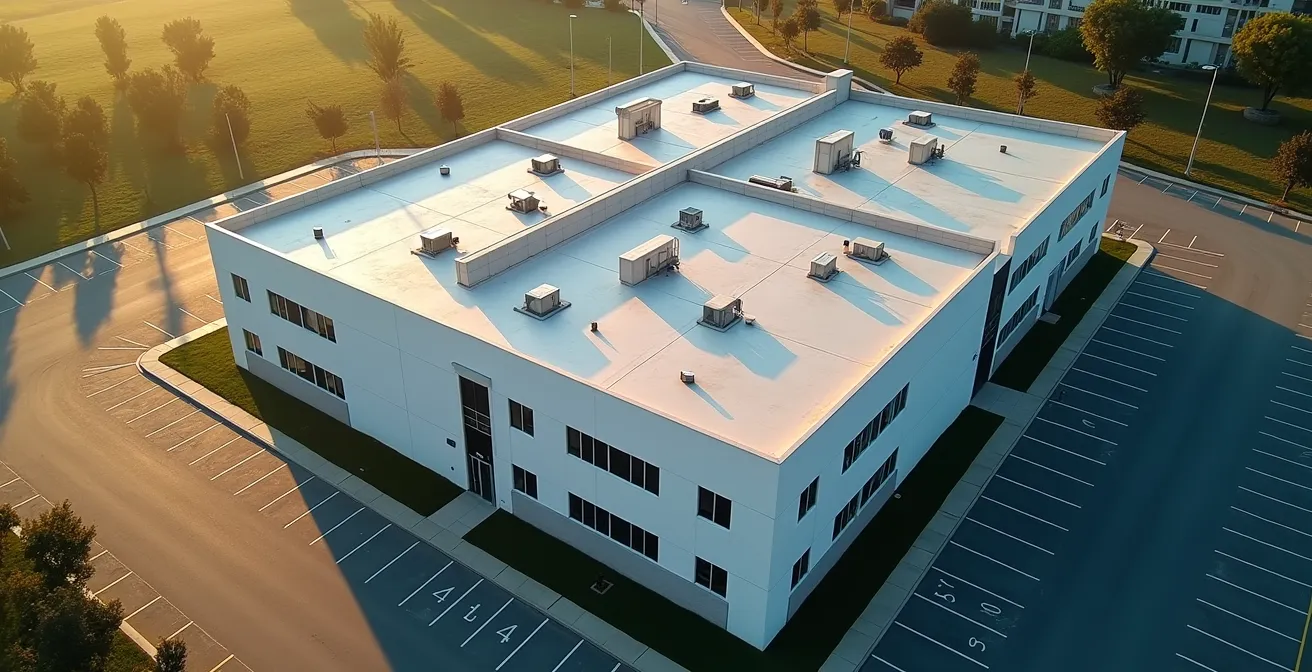
As this visual suggests, a single building can house multiple distinct operational zones, each with its own risk profile. Even if you only sublet a small office, you assume liability for that space. An LRO policy acknowledges this division of risk and ensures you are protected from incidents over which you have little direct control. It is designed to cover your liability *as a lessor*, separate from your liability as a business operator in the portion of the building you occupy.
Implementing this coverage should be part of a broader risk management strategy when subletting. Best practices include requiring your tenant to carry their own liability insurance and list you as an “Additional Insured” on their policy. You should also have a “Separation of Insureds” clause in your own policy, which treats you and your tenant as separate entities, preventing your insurer from denying a claim based on the tenant’s actions. These steps, combined with an LRO policy, create a robust shield against the contingent liabilities of being a landlord.
Contingent Business Interruption: What If Your Key Supplier Burns Down?
Your business can be forced to a halt even if your own property is perfectly intact. A fire, flood, or other disaster at the facility of a key supplier or a primary customer can cripple your operations. Standard Business Interruption (BI) insurance only covers income lost due to damage at *your own* premises. To protect against this external systemic risk, you need Contingent Business Interruption (CBI) coverage.
CBI is an endorsement that extends your BI policy to cover profit losses stemming from a physical loss at the property of a third party you depend on. This third party is typically categorized in one of three ways:
- Contributing Properties (Suppliers): Businesses that supply you with the parts, materials, or services needed to produce your goods.
- Recipient Properties (Customers): Businesses that purchase the majority of your products or services.
- Manufacturing Properties (Outsourcers): Businesses that manufacture your products for you.
The first step in securing adequate CBI coverage is to conduct a thorough supply chain dependency mapping. This involves identifying all your single-source or critical suppliers and quantifying the financial impact their sudden absence would have on your revenue. As demonstrated in strategic analyses by firms like PwC, companies that effectively map these critical relationships can more accurately justify appropriate coverage limits based on actual dependency risks. It’s not enough to say a supplier is “important”; you must be able to show an underwriter that a 30-day shutdown at Supplier X would result in a specific, calculable drop in your own production and sales.
This process of value underwriting is what separates basic coverage from strategic risk management. By identifying the nodes in your value chain that represent the greatest contingent risk, you can secure CBI coverage that is precisely tailored to protect your operational continuity. This transforms your insurance policy from a reactive safety net into a proactive tool for managing the systemic risks inherent in a modern, interconnected business environment.
Scheduled Personal Property vs. Blanket Coverage: Which is Best for Jewelry?
While the term “jewelry” evokes personal insurance, the same principle applies to high-value, unique business assets. Think of corporate art collections, irreplaceable prototypes, specialized scientific instruments, or bespoke diagnostic tools. A standard property policy often groups these items under a general “Business Personal Property” limit, with restrictive sub-limits for specific categories. For high-value items, this can lead to significant coverage gaps. The strategic choice is between blanket coverage and scheduled property coverage.
Blanket coverage provides a single, aggregate limit for a broad category of items. It’s simpler to manage but often comes with a per-item limit (e.g., $2,500 per piece of art). If you have many similar items of moderate value, this can be efficient. However, if a single item’s value exceeds that sub-limit, you are underinsured. In contrast, a Scheduled Property endorsement (or “floater”) allows you to list specific items individually, each with its own agreed-upon value based on a formal appraisal. This provides much more precise and comprehensive protection for unique, high-value assets.
The decision of whether to schedule an item is a financial one. A good rule of thumb is to schedule any single item valued over $5,000 or whose value exceeds 10% of your total blanket limit. This ensures your most critical and valuable assets are fully protected at their appraised worth. When a claim occurs on a scheduled item, the process is straightforward, as the value has already been agreed upon, avoiding difficult post-loss negotiations. This table clarifies the trade-offs.
This comparative data, based on guidance from industry leaders like The Hartford’s analysis of business coverage, illustrates the strategic choice a CFO must make.
| Coverage Aspect | Scheduled Property | Blanket Coverage |
|---|---|---|
| Item Documentation | Individual appraisal required | General inventory list |
| Coverage Limit | Specific value per item | Aggregate limit with sub-limits |
| Premium Cost | Higher for comprehensive coverage | Lower but with restrictions |
| Claims Process | Straightforward with pre-agreed values | May require post-loss valuation |
| Best For Assets | Over $5,000 or 10% of total limit | Multiple similar items under $5,000 |
For scheduled items, it is crucial to keep appraisals updated (typically every 1-3 years) to account for market value changes and inflation. An “inflation guard” clause can also be added to automatically increase coverage limits annually by a set percentage, ensuring your protection keeps pace with the asset’s appreciating value.
Parking Insurance: Do You Need Fire & Theft for a Car That Never Moves?
The question of insuring a stationary vehicle extends to any piece of mobile equipment or company fleet vehicle that is taken out of service for an extended period. This is common for businesses with seasonal operations (e.g., landscaping, construction) or those with a backup fleet. Paying for full commercial auto insurance, including collision and liability, on a vehicle that is sitting in storage is an unnecessary expense. However, canceling the policy entirely leaves the asset vulnerable to risks like fire, theft, vandalism, or weather damage. The solution is to scale down to a comprehensive-only or “storage” policy.
This strategy allows you to suspend the more expensive coverages associated with road use—namely liability and collision—while retaining protection for non-collision events. This can lead to significant premium savings. For example, a case study highlighted by the SBA showed how one construction company saved 40% on annual premiums for its seasonal fleet by implementing “Suspension of Coverage” endorsements during the winter off-season. The key to this strategy is proper documentation and communication with your insurer.
Before suspending coverage, you must provide the insurer with details about the storage conditions. A secure, locked facility is ideal. You must also give the insurer formal notice before the vehicle is put back into service, as they may require an inspection to ensure it’s in good working order before reinstating full coverage. Failing to reactivate the policy before the vehicle is driven can result in a denied claim if an accident occurs. This approach provides a smart way to manage costs without creating a total loss exposure on a valuable, albeit static, asset.
Key Takeaways
- Asset valuation must extend beyond physical cost to include operational value, such as using Customer Lifetime Value (CLV) for a customer database.
- Dynamic risks, including tools in transit and supply chain disruptions, require specialized coverage like inland marine and Contingent Business Interruption (CBI), not just standard property policies.
- Proactive risk management, from meticulous documentation to creating recovery playbooks, is as critical as the insurance policy itself for ensuring business continuity.
How to Resume Operations Quickly After Critical Machinery Failure?
When a piece of mission-critical machinery fails, the direct cost of repair is often dwarfed by the cost of the resulting downtime. Every hour the machine is offline can mean thousands in lost revenue and production delays. A standard property policy might cover the repair, but it won’t cover the extraordinary costs required to get back online *fast*. This is the domain of Equipment Breakdown Insurance, specifically its “Expediting Expenses” and “Ordinance or Law” provisions.
Equipment Breakdown Insurance (also known as Boiler and Machinery insurance) is designed to cover losses from the sudden and accidental breakdown of machinery and equipment. Crucially, it goes beyond simple repair costs. The Expediting Expenses portion of the coverage pays for the extra costs necessary to make temporary repairs or to speed up permanent repairs. This can include air freight for replacement parts, overtime pay for repair technicians, or costs to bring in specialized external expertise.
Another critical component is Ordinance or Law coverage. If a failed machine must be replaced, and local building codes now require a more expensive, upgraded model, this provision covers the increased cost of compliance. Without it, you would be responsible for the difference in cost between the old model and the new, code-compliant one. Having these coverages in place transforms your insurance from a passive reimbursement tool into an active recovery resource.
Your Action Plan: Critical Machinery Recovery Playbook
- Activate ‘Expediting Expenses’ coverage immediately to authorize costs for air freight and technician overtime.
- Contact pre-approved repair services from your insurer’s preferred vendor list to ensure quality and streamline billing.
- Deploy rental equipment using pre-negotiated agreements to maintain partial operational continuity during the repair.
- Access a digital library of stored equipment schematics and part specifications to provide to the repair team instantly.
- Initiate an ‘Ordinance or Law’ coverage review with your agent to determine if required upgrades will be covered.
A well-documented recovery playbook, like the one above, is the key to minimizing downtime. By having vendors, rental agreements, and coverage triggers defined *before* an incident occurs, you can compress the recovery timeline from weeks to days. This proactive stance on operational continuity is the ultimate form of asset protection.
The logical next step is to transform this strategic awareness into a quantifiable risk assessment for your own operations. Begin by mapping your dependencies, valuing your intangible assets, and identifying where your current policies fall short of protecting your true operational value.
Frequently Asked Questions About Insuring Business Assets
Is flood damage from a burst pipe covered under storage insurance?
Most comprehensive-only or storage policies cover water damage from sudden and accidental events like burst pipes, but it is critical to verify that this specific peril is listed in your policy endorsement. Exclusions for general flooding from external water sources usually still apply.
Does moving stored equipment across the yard void coverage?
Minor repositioning of an asset within the same insured premises typically does not affect a comprehensive-only storage policy. However, operating the equipment for work or moving it off-site would be considered a material change in risk and requires reactivating the full liability and collision policy beforehand.
What inspections are required before reactivating coverage?
Before reinstating full coverage on a vehicle or piece of equipment that has been in long-term storage, insurers may require a mechanical inspection to verify its operational safety. They will also likely ask for updated photographs and require written notice 24-48 hours before the asset is put back into service.