
Your policy’s real value isn’t its coverage amount, but its specific, often-hidden ‘failure points’ that can nullify a claim.
- Policy language is designed to limit liability; terms like “hostile fire” and “diligent pursuit” are critical failure points.
- Standard coverage limits (like 12-month indemnity periods) are often insufficient in the wake of a widespread disaster.
Recommendation: Adopt an adversarial reading of your policy to identify and mitigate these risks before a disaster occurs.
For a homeowner, an insurance policy represents a promise of security—a financial backstop against catastrophe. The common advice is to “read your policy” and “document your belongings,” creating a sense of diligence. However, this superficial review often misses the most critical aspect of insurance: a policy is not a blanket of protection but a highly technical legal contract. It is engineered with specific triggers, exclusions, and conditions designed to manage the insurer’s risk, not necessarily to ensure your complete recovery.
This analytical approach moves beyond simply checking for coverage. It involves an adversarial reading of the document, treating it as a system with potential failure points. The most devastating financial losses often stem not from a lack of coverage, but from a failure to meet a granular condition tucked away in the policy’s definitions. A fire is not just a fire; a flood is not just a flood. The origin, the homeowner’s actions, and the precise wording of the indemnity clause determine the outcome.
The true measure of a policy’s strength is how it performs under the stress of a real-world disaster scenario. This guide will dissect the fine print of fire and flood guarantees. We will analyze the subtle but significant distinctions that can void a claim, probe the limitations of expense coverage, and stress-test the very definitions that insurers rely on to limit their liability. The goal is to equip you with the skeptical mindset of a disaster scenario modeler to find and fortify the weaknesses in your coverage before you ever need to file a claim.
For a broad overview of the role of different insurance types, the following video offers a foundational perspective. It serves as a general introduction before we dive into the critical details of your specific policy guarantees.
To conduct this stress-test effectively, we will deconstruct your policy’s guarantees section by section. The following analysis breaks down the most common and costly failure points related to fire, flood, and post-disaster living expenses, providing the insights needed to pressure-test your own coverage.
Table of Contents: A Deep Dive into Your Policy’s Fine Print
- Why Chimney Fires Might Be Treated Differently Than Electrical Fires?
- How to secure ‘Additional Living Expenses’ While Your Home is Uninhabitable?
- Flat Deductible vs. Percentage Deductible: Which is Safer for Hurricane Zones?
- The Wiring Issue That Could Void Your Fire Guarantee in Older Homes
- How to Ensure Smoke Remediation is Fully Covered Alongside Fire Damage?
- What to Do in the First Hour of a Flood to Save Your Flooring?
- The 12-Month Trap: Why You Need Longer Indemnity Periods for Rebuilding?
- How to Ensure Smoke Remediation is Fully Covered Alongside Fire Damage?
Why Chimney Fires Might Be Treated Differently Than Electrical Fires?
From a homeowner’s perspective, fire is fire. From an insurer’s analytical standpoint, the origin of the fire is a critical data point that can trigger specific and often disadvantageous policy clauses. The distinction between a fire originating in a chimney versus one from faulty wiring hinges on a legal concept known as the “friendly vs. hostile fire” doctrine. This doctrine is a primary failure point for many claims and one that detail-oriented homeowners must understand.
A “friendly fire” is one that is intentionally lit and remains in its intended place, such as a fire in a fireplace or a wood stove. A “hostile fire” is one that escapes its intended container or was never intended to be lit. An electrical fire is almost always considered hostile by default. However, a chimney fire presents a gray area. Insurers can argue that if the fire originated from the “friendly” fire in the hearth and spread due to homeowner negligence—such as a documented failure to clean creosote buildup—the subsequent damage is not covered. They may classify it as a friendly fire that got out of control due to a breach of duty of care.
This legal interpretation allows insurers to shift the burden of proof onto the homeowner. To counter this, you must maintain meticulous records. According to legal analysis of denied claims, a robust defense requires proof of regular maintenance. This includes receipts for annual chimney inspections by certified professionals and logs of chimney sweeping. Without this documentation, an insurer has a clear pathway to argue negligence and limit or deny the claim, treating a catastrophic chimney fire very differently than an unpredictable electrical malfunction. This is confirmed by legal experts who note that reasons for insurance companies denying fire claims often revolve around maintenance and negligence.
How to secure ‘Additional Living Expenses’ While Your Home is Uninhabitable?
Additional Living Expenses (ALE) coverage is a critical lifeline designed to cover the increased costs of living elsewhere while your home is being repaired. However, “covered” does not mean “unlimited.” Securing these funds requires a rigorous, evidence-based approach, as adjusters scrutinize every expense against the policy’s specific definitions. The first hurdle is the term “comparable standard of living.” This does not mean an upgrade; it refers to a rental property with similar square footage, number of rooms, and essential amenities to your damaged home.
The duration of ALE is another significant failure point. Coverage typically continues only as long as the home is uninhabitable and rebuilding efforts are being “diligently pursued.” If an insurer feels repairs are lagging without a valid reason, they can terminate payments. This puts immense pressure on homeowners who may be facing contractor delays or supply chain issues. While payments are typically made on a reimbursement basis, it is possible to negotiate for advances. For immediate needs like a hotel stay or a rental deposit, homeowners can and should request upfront payments from the adjuster, though this is at their discretion.

The key to maximizing ALE is impeccable record-keeping from day one. This means saving every single receipt for lodging, food costs above your normal budget, laundry, and transportation. Create a detailed spreadsheet that categorizes these expenses and clearly demonstrates the delta between your normal living costs and your temporary ones. This documentation is not just for your records; it is the evidence you will submit to the adjuster to justify every dollar of your claim.
Flat Deductible vs. Percentage Deductible: Which is Safer for Hurricane Zones?
For homeowners in areas prone to named storms, the type of hurricane deductible on their policy is one of the most significant financial risks they face. Unlike a standard “all-peril” deductible, which is a fixed dollar amount, a hurricane deductible is often a percentage of the home’s insured value. This seemingly small distinction in the policy can lead to a catastrophic difference in out-of-pocket costs after a disaster. A rigorous analysis shows that a percentage-based deductible poses a far greater financial exposure.
As an example, a homeowner with a $400,000 policy and a 5% hurricane deductible would be responsible for the first $20,000 of repairs from a named storm, not the $1,000 or $2,000 they might pay for a fire claim. This exposure scales with the home’s value, meaning that as property values and construction costs rise, so does the homeowner’s mandatory contribution. A flat dollar deductible, by contrast, offers predictability. The amount is fixed regardless of the home’s insured value, making it much easier to budget for in an emergency fund.
The following table, based on a comparative analysis of hurricane deductibles, clearly illustrates the disparity in risk.
| Deductible Type | Typical Range | Example on $600,000 Home | Risk Level |
|---|---|---|---|
| Percentage-Based Hurricane | 1-5% (up to 10% high-risk) | $6,000-$30,000 | High financial exposure |
| Flat Dollar Hurricane | $2,000-$10,000 | Fixed amount regardless of home value | Predictable exposure |
| Calendar Year Application | Once per year (FL) | Single deductible for multiple storms | Limited annual exposure |
In high-risk coastal zones, opting for a policy with a flat dollar hurricane deductible, even if it means a slightly higher premium, is a fundamentally safer financial strategy. It transforms an unpredictable, potentially ruinous liability into a known, manageable expense.
The Wiring Issue That Could Void Your Fire Guarantee in Older Homes
For owners of older homes, “grandfathered” electrical systems represent a major, often overlooked, policy vulnerability. While the wiring may have been up to code when the house was built, its capacity is frequently insufficient for the demands of modern life. Insurers are increasingly leveraging this mismatch to deny fire claims, citing a specific form of homeowner negligence: knowingly overloading an archaic system.
The failure point is not the old wiring itself, but its interaction with high-draw modern appliances. Devices like electric vehicle (EV) chargers, portable air conditioning units, or high-powered entertainment systems place a load on circuits that they were never designed to handle. If a fire originates from an overloaded circuit, the insurer can argue that the homeowner was negligent. They will contend that even without being an electrician, a reasonable person should know that plugging high-consumption devices into a decades-old system is a significant risk. This argument allows them to void the fire guarantee, leaving the homeowner with a total loss.
This creates a critical need for proactive documentation and, where necessary, upgrades. An insurer’s investigation will scrutinize the electrical system’s condition and any recent additions. To defend against a negligence-based denial, a homeowner must be able to produce evidence of due diligence.
Action Plan: Electrical System Audit for Policy Compliance
- Obtain a Four-Point Electrical System Inspection from a licensed electrician before each policy renewal.
- Document all electrical work, no matter how minor, and ensure proper permits are pulled and filed.
- Keep detailed records of any modifications or additions made to the home’s original wiring.
- Photo-document the state of your junction boxes and electrical panel, especially after any upgrades.
- Maintain proof of having immediately addressed any deficiencies or recommendations noted in professional inspections.
Without this paper trail, you are handing the insurer the leverage to classify a fire as the result of negligence rather than an accident, effectively nullifying your coverage when you need it most.
How to Ensure Smoke Remediation is Fully Covered Alongside Fire Damage?
After a fire, the visible damage from flames is often just the beginning. Pervasive smoke and soot can cause extensive, long-term damage that is far more difficult and expensive to remediate. Securing full coverage for smoke damage requires a proactive and evidence-based strategy, as insurers will often attempt to cover only the most superficial cleaning. The key is to prove that smoke damage is not a cosmetic issue but a structural one.
Smoke particles are microscopic and acidic, allowing them to penetrate deep into porous materials like drywall, insulation, wood framing, and textiles. Simply cleaning the surface with detergents does not remove the embedded particles or the persistent, hazardous odor. True remediation often requires the complete removal and replacement of these materials. This is where the conflict with the insurer begins. Their initial assessment will likely favor cheaper, less effective methods like ozone treatments or surface wiping.
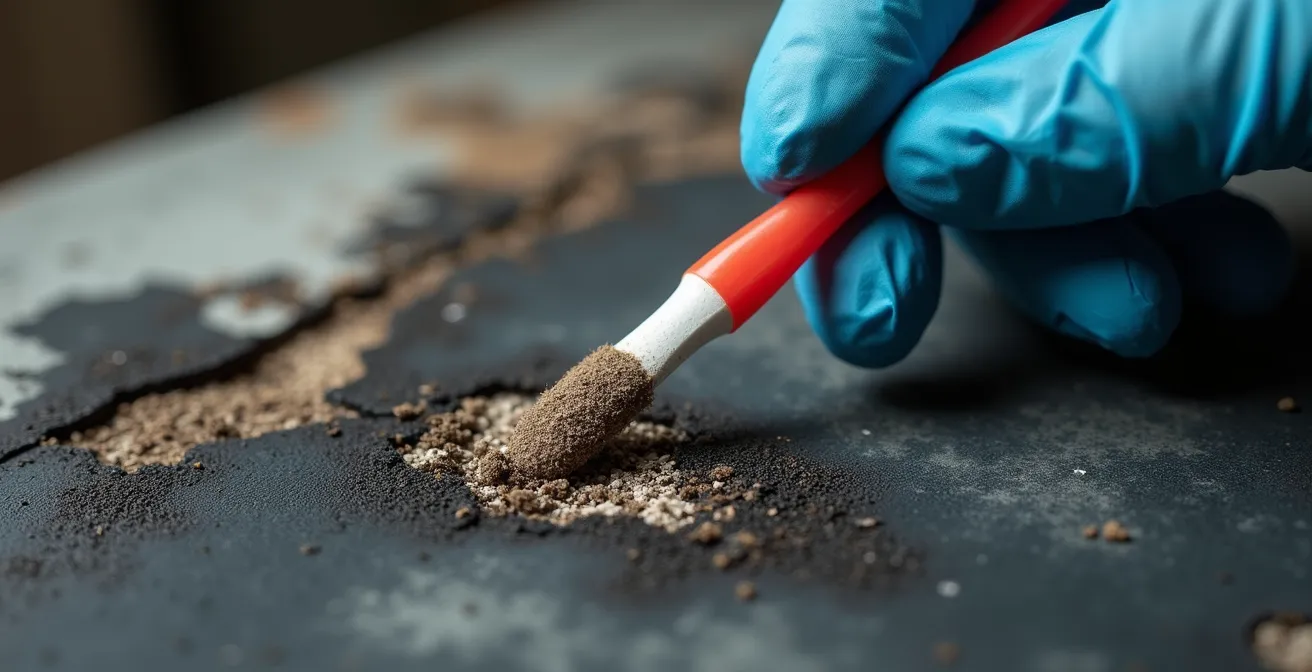
To counter this, you must build an undeniable case for comprehensive remediation. This starts with hiring an independent industrial hygienist to conduct air quality and surface tests. Their report, which will identify the type and concentration of soot particles, becomes your primary piece of evidence. It provides a scientific, third-party validation that the damage is more than skin-deep and that porous materials are contaminated beyond salvage. This expert report shifts the argument from the insurer’s opinion to scientific fact, making it significantly harder for them to justify a lowball offer for surface-level cleaning.
What to Do in the First Hour of a Flood to Save Your Flooring?
In the immediate aftermath of a flood, the instinct is to start cleaning up immediately. This is a critical mistake. The first hour of a flood is not for mitigation; it is for evidence collection. Every action you take before fully documenting the damage can weaken your insurance claim. Your primary objective is to create an indisputable record of the water’s peak and its direct impact on your property, especially valuable components like flooring.
Before moving a single piece of furniture or touching a wet floorboard, you must document the scene. Use your smartphone to take extensive video and photos. The most crucial evidence is the high-water mark on walls, furniture, and appliances. Capture these lines from multiple angles and use a measuring tape in the photo for scale to show precisely how many inches of water entered the home. This visual proof is your strongest defense against an insurer attempting to downplay the extent of the inundation.
Once visual documentation is complete, your next step is to formally notify your insurer. Send a written notice via email, stating the date and time of the loss and that you are beginning emergency mitigation efforts. This creates a time-stamped record of communication. It is also vital to identify the water category. Water from an exterior flood is automatically considered Category 3 or “black water”, meaning it is grossly contaminated. According to guidance from programs like the National Flood Insurance Program, this classification justifies the complete removal and replacement of all porous materials it touched, including carpet, padding, and often the subfloor. Only after these steps are complete should you begin removing wet materials.
- Take extensive video and photos showing water level marks on walls before moving anything.
- Document all high-water marks with a measuring tape in the frame for scale.
- Notify your insurer in writing (email is best) before beginning any mitigation work.
- Identify the water as Category 3 (contaminated), which justifies removal, not just cleaning.
- Begin removing wet materials only after the documentation and notification are complete.
Key Takeaways
- Policy language is designed to limit liability; terms like “hostile fire” and “diligent pursuit” are critical failure points.
- Standard coverage limits, like 12-month indemnity periods, are often insufficient in the wake of a widespread disaster due to contractor and material bottlenecks.
- Meticulous, pre-mitigation documentation is your primary leverage in a claim dispute, especially for flood and smoke damage.
The 12-Month Trap: Why You Need Longer Indemnity Periods for Rebuilding?
A standard homeowners policy often contains a 12-month indemnity period for both Additional Living Expenses (ALE) and the time allotted to complete repairs. In a normal scenario, this seems adequate. However, in the aftermath of a large-scale disaster like a hurricane or wildfire, this 12-month window becomes a dangerous trap. Widespread destruction creates an unprecedented surge in demand for qualified contractors, building materials, and municipal permits, leading to systemic delays that make a one-year timeline completely unrealistic.
Case studies from major events consistently show this failure point in action. Following Hurricane Ian, for example, contractor waitlists in affected regions frequently exceeded 12 months before work could even begin. Homeowners with standard policies found their ALE coverage exhausted long before their homes were livable, forcing them to cover both a mortgage on a damaged house and exorbitant rental costs out-of-pocket. The 12-month clock starts ticking from the date of the loss, not from the date a contractor is available.
This problem is compounded by severe cost inflation. The same market forces that create labor shortages also drive up the price of materials. Data shows a staggering 43% increase in home replacement costs in the five years leading up to October 2024. A policy’s coverage amount, which may have been adequate when purchased, can quickly become insufficient to cover a rebuild a few years later, especially after a disaster inflates prices further. The solution is to proactively negotiate for extended coverage. Many insurers offer endorsements that extend the indemnity period to 24 or even 36 months. This extension is a crucial buffer that provides the financial stability needed to navigate the long and unpredictable post-disaster rebuilding process.
How to Ensure Smoke Remediation is Fully Covered Alongside Fire Damage?
Once you have scientifically proven the extent of smoke contamination, the next phase is the contractual battle to ensure the remediation is fully funded. Insurers are financially motivated to approve the cheapest possible solution, which is almost always superficial cleaning. Your goal is to force them to adhere to industry standards for permanent odor and particle removal, which means replacing, not just cleaning, porous materials.
The leverage you have is your independent industrial hygienist’s report. This document is the foundation of your argument. When the adjuster proposes surface cleaning or fogging, you counter with the report’s evidence of deep contamination in drywall, insulation, or wood. The conversation must be shifted from “cleaning” to “restoring the home to its pre-loss condition,” a phrase typically found in the policy itself. Surface cleaning does not meet this standard if the underlying materials remain a source of hazardous particles and odor.
This is a point of intense negotiation, and you must be prepared for pushback. As property damage experts in the fire restoration industry note, the default position of many insurers is to minimize costs. As they state, it’s a constant struggle:
Insurers will often push for simple surface cleaning. True remediation for pervasive smoke odor involves removing and replacing porous materials.
– Property damage experts, Fire damage restoration industry standards
Do not accept an initial offer that relies solely on cleaning. Insist that the remediation plan explicitly includes the removal and replacement of all materials identified as contaminated in your expert’s report. If the adjuster refuses, the next step is to invoke the policy’s appraisal clause or consult with a public adjuster or attorney. Standing firm, with scientific data as your backing, is the only way to ensure your smoke remediation is comprehensive and permanent.
To truly protect your assets, the next logical step is a rigorous, line-by-line adversarial review of your current policy. Begin your stress-test now before a disaster forces the issue.
Frequently Asked Questions on Homeowners Insurance Claims
What defines ‘comparable standard of living’ for ALE purposes?
Comparable means similar square footage, number of bedrooms/bathrooms, and essential amenities to your damaged home, not just any available housing.
How long does ALE coverage typically last?
Coverage continues while your home is uninhabitable but can be terminated if rebuilding efforts are not ‘diligently pursued’ with documented progress.
Can I get ALE payments in advance?
While typically reimbursement-based, you can negotiate with adjusters for upfront advances, especially for immediate housing needs.