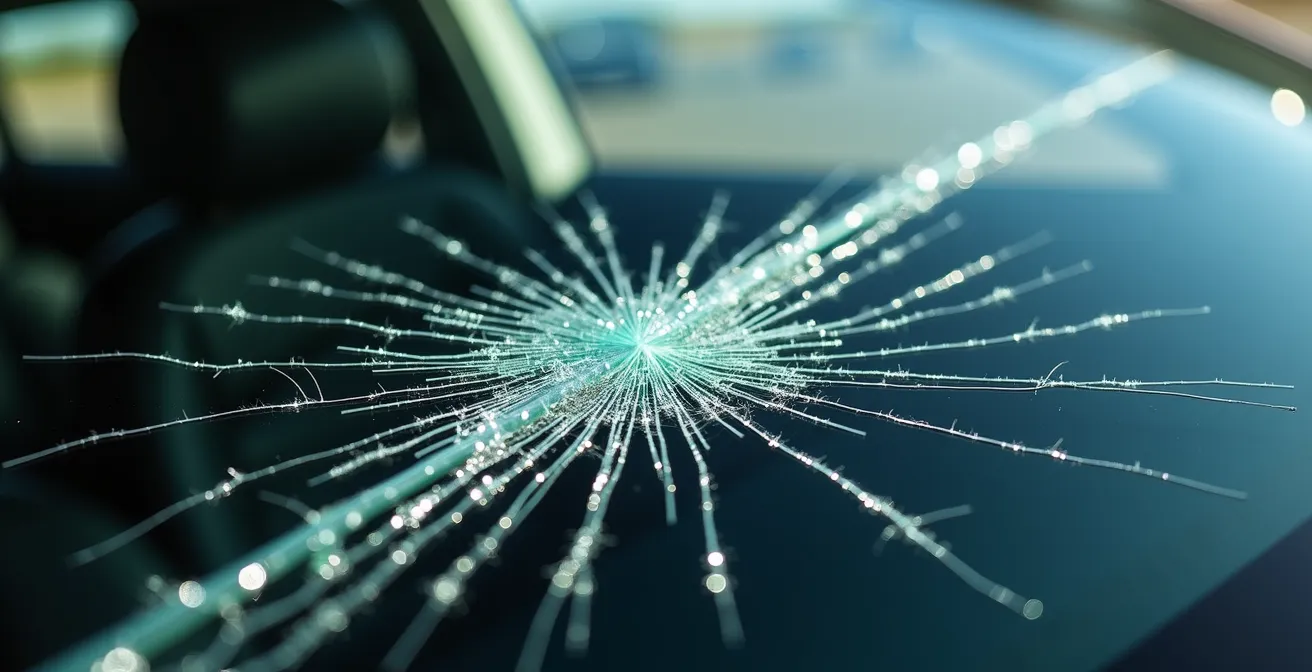
A “free” windshield chip repair isn’t a perk; it’s your insurer’s calculated move to prevent a mandatory, $1,000+ replacement driven by high-tech sensors.
- Chip repair is a simple, low-cost resin injection, while modern replacements require expensive recalibration of Advanced Driver-Assistance Systems (ADAS).
- Ignoring a small chip compromises up to 70% of the windshield’s structural integrity, turning a preventable fix into a major safety failure.
Recommendation: Address any chip or crack smaller than a dollar bill immediately. This locks in the zero-deductible repair, avoids a massive bill, and maintains your vehicle’s core safety systems.
It’s a sound every highway commuter dreads: the sharp crack of a stone hitting the windshield. The initial relief of seeing a tiny chip instead of a spiderweb crack is often followed by a wave of annoyance. Your first instinct might be to ignore it, or to brace for a frustrating call with your insurance company and a hefty deductible payment. Many drivers believe that any glass damage automatically means paying out of pocket, at least partially. This assumption, however, overlooks the fundamental economics and engineering that govern auto glass claims.
The truth from a technician’s standpoint is that the path to a zero-deductible outcome isn’t a loophole or a special promotion. It is a calculated strategy rooted in preventative maintenance, driven entirely by your insurer’s desire to avoid a much larger, more complex, and technologically intensive cost: a full windshield replacement. The modern windshield is no longer just a piece of glass; it’s a critical component of your vehicle’s structural integrity and the platform for its most advanced safety systems.
This article will break down the technical reasons behind your insurer’s decisions. We will dissect why a small repair is proactively encouraged and often paid for in full, while a full replacement has become a surprisingly expensive procedure. Understanding this dynamic is the key to managing windshield damage effectively, saving money, and ensuring your vehicle remains safe on the road.
text
This guide provides a technician’s perspective on navigating windshield damage claims. You will learn the critical differences between repair and replacement, the technology that dictates cost, and the specific insurance mechanisms that can save you from paying a deductible.
Summary: Navigating Windshield Damage and Insurance Deductibles
- Why Insurers Waive the Deductible for Chip Repairs but Not Replacements?
- How a Simple Windshield Replacement Can Cost $1,000 Due to Sensors?
- OEM Glass vs. Aftermarket: Will Your Insurer Pay for the Original Logo?
- The Frequency Error: Can Three Glass Claims in a Year Get You Cancelled?
- When to Fix a Chip: The Temperature Shift That Cracks Your Windshield Instantly
- Why a Falling Tree Branch is Only Covered Under Comprehensive Plans?
- How to Add Glass Coverage to a Third-Party Policy for Under $5/Month?
- How a Simple Windshield Replacement Can Cost $1,000 Due to Sensors?
Why Insurers Waive the Deductible for Chip Repairs but Not Replacements?
The decision by insurers to waive deductibles for windshield repairs is not an act of generosity; it’s a strategic financial decision known as loss prevention. From a purely economic standpoint, a repair is vastly preferable to a replacement. The core of this strategy lies in the significant cost difference between the two procedures. A professional resin injection to fix a small chip is a quick process that stabilizes the glass and restores its structural integrity.
This simple fix is a minor expense for the insurer. Data shows a typical chip repair costs between $40 and $100, while a basic replacement starts at $250 and can easily exceed $400 for standard vehicles. By offering to cover the small cost of a repair in full, the insurance company incentivizes you to act quickly. This prevents the chip from spreading into a larger, unrepairable crack that would mandate a full, expensive replacement for which they would be liable (minus your deductible).
Many insurers formalize this policy. For example, Progressive often waives the comprehensive deductible for any repairable crack that is less than 6 inches long. This policy directly demonstrates how a “free” repair is an investment. Paying $100 today prevents a potential claim of $400 or more tomorrow. Furthermore, a chip compromises the windshield’s role in vehicle safety. A timely repair restores the glass, reducing the insurer’s liability in the event of an accident where the compromised windshield fails to perform correctly.
How a Simple Windshield Replacement Can Cost $1,000 Due to Sensors?
The days of a windshield being a simple sheet of laminated glass are long gone. Today, it serves as a critical mounting point for the sophisticated sensor arrays of your vehicle’s Advanced Driver-Assistance Systems (ADAS). These systems, which include features like lane-keeping assist, forward collision warning, and adaptive cruise control, rely on cameras and sensors that are precisely positioned on the windshield. When the windshield is replaced, this entire system must be recalibrated to function correctly.
This recalibration process is what transforms a once-straightforward replacement into a complex, high-cost technical procedure. Calibration ensures the sensors are aimed with millimeter precision, as even a tiny deviation can cause the safety systems to misinterpret data, potentially leading to catastrophic failure. There are two types of calibration: static (performed in a workshop with specialized targets) and dynamic (performed by driving the vehicle under specific conditions). Many modern vehicles require both.
The breakdown of costs reveals why the price tag escalates so quickly. While the glass itself might only be a fraction of the total, the labor and, most significantly, the calibration drive up the final bill. The following table illustrates how these advanced requirements inflate the total cost compared to a standard vehicle without ADAS.
This detailed cost comparison, based on data from auto glass specialists, highlights the non-negotiable expense of calibration. As a breakdown of ADAS windshield costs shows, calibration alone can add up to $600 to the bill.
| Component | Standard Vehicle | ADAS-Equipped Vehicle |
|---|---|---|
| Glass | $200-300 | $300-400 |
| Labor | $100-150 | $150-200 |
| Calibration | N/A | $200-600 |
| Total | $300-500 | $650-1,200 |
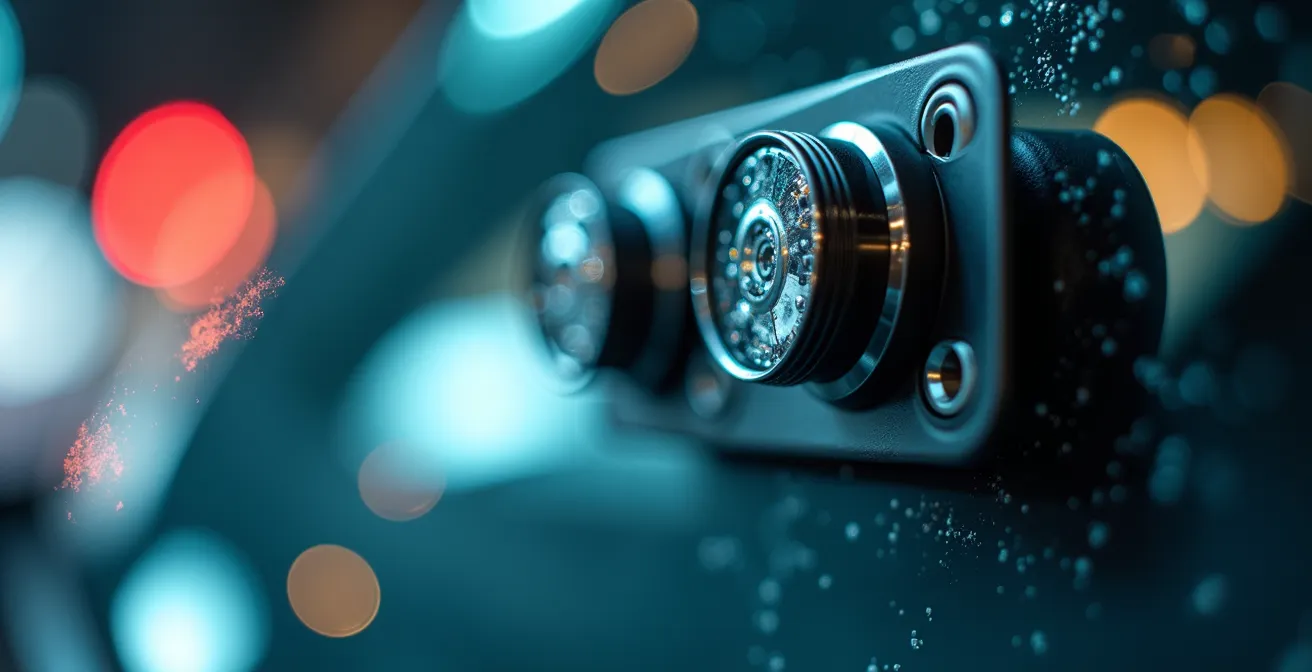
As you can see, the technology embedded within the windshield is intricate and essential for safety. The calibration is not an optional upsell; it is a mandatory safety procedure required by vehicle manufacturers to ensure the life-saving ADAS features work as designed after a replacement.
OEM Glass vs. Aftermarket: Will Your Insurer Pay for the Original Logo?
When a replacement is necessary, a critical question arises: should you use Original Equipment Manufacturer (OEM) glass or a less expensive aftermarket equivalent? OEM glass is produced by the same company that made the original glass for your vehicle, guaranteeing a perfect fit, color, and, most importantly, the precise optical quality required for ADAS to function. Aftermarket glass is made by a third party and, while it must meet federal safety standards, it may have subtle variations in thickness, curvature, and clarity.
From a technician’s perspective, this is not just about having the car brand’s logo on the glass. These subtle differences can have a major impact. As experts from Alfa Insurance note, crucial safety features are directly linked to the windshield’s properties. They state:
Car features like lane assistance, traffic sign recognition, and adaptive cruise control are likely dependent on the windshield for their sensors and cameras.
– Alfa Insurance, Alfa Insurance windshield coverage guide
An aftermarket windshield with slightly different light transmission or distortion, however minor, can prevent ADAS cameras from calibrating correctly or cause them to misread road signs and lane markings. This is why many vehicle manufacturers issue Technical Service Bulletins (TSBs) mandating the use of OEM glass for replacements to guarantee safety system performance.
However, most standard insurance policies will only cover the cost of an aftermarket windshield due to its lower price. If you or your repair facility insist on OEM glass, you may be required to pay the price difference out of pocket. To ensure coverage for OEM glass, you often need a specific “OEM endorsement” on your policy, which may come with a slightly higher premium. Without this endorsement, getting your insurer to cover OEM glass often requires a negotiation focused on safety, citing manufacturer TSBs as evidence that it’s a necessity, not a preference.
The Frequency Error: Can Three Glass Claims in a Year Get You Cancelled?
While a zero-deductible chip repair feels like a freebie, it’s crucial to remember that it is still a claim recorded on your policy history. Insurance companies track claim frequency to assess risk. A driver who files multiple claims in a short period, even for minor, no-fault incidents like glass damage, can be reclassified as a higher risk. This can lead to premium increases at your next renewal or, in extreme cases, non-renewal of your policy.
There’s no universal rule, but an industry guideline suggests that filing three or more claims within a three-year period often triggers an underwriting review. This includes glass claims. Therefore, a strategic error many drivers make is filing a claim for a very low-cost repair that they could have easily paid for out of pocket. Paying $75 yourself for a chip repair might be wiser than filing a third claim that could lead to a premium hike of several hundred dollars over the next few years.
This creates a critical decision point for every instance of glass damage: pay for it yourself or file a claim? The answer depends on the cost of the repair, your deductible, and your recent claims history. For small chips, especially if you’ve had other claims recently, paying out of pocket is often the most financially prudent long-term decision.
Your 5-Point Audit Before Filing a Glass Claim
- Assess the Damage: Is it a small chip (repairable) or a large crack (replacement)? Get a quote from a qualified glass technician.
- Check Your Deductible: Compare the repair/replacement quote directly to your comprehensive deductible amount. Is the cost significantly lower than the deductible?
- Review Your Claims History: Have you filed any auto insurance claims (glass or otherwise) in the last three years? If you have two or more, be cautious.
- Calculate the True Cost: If the repair cost is under $200 and would be your second or third claim, consider the risk of a future premium increase versus the immediate out-of-pocket expense.
- Make the Decision: For low-cost repairs on a policy with a recent claim history, pay out of pocket. For high-cost replacements that far exceed your deductible, use your insurance.
When to Fix a Chip: The Temperature Shift That Cracks Your Windshield Instantly
The single most important factor in determining whether a windshield chip is a minor inconvenience or a major expense is time. A small chip or “bullseye” is a structural weak point in the glass. While it may seem stable, a small chip or crack reduces the strength of a windshield by up to 70%. This compromised integrity makes the glass highly vulnerable to stress, and the most common source of that stress is temperature change.
This phenomenon is known as thermal shock. Glass expands when heated and contracts when cooled. When this happens unevenly or too quickly across the surface of the windshield, it creates immense internal pressure. A pristine windshield can handle this, but one with a chip has a built-in failure point. The stress concentrates at the tip of the chip, forcing it to expand into a long, unrepairable crack in an instant.
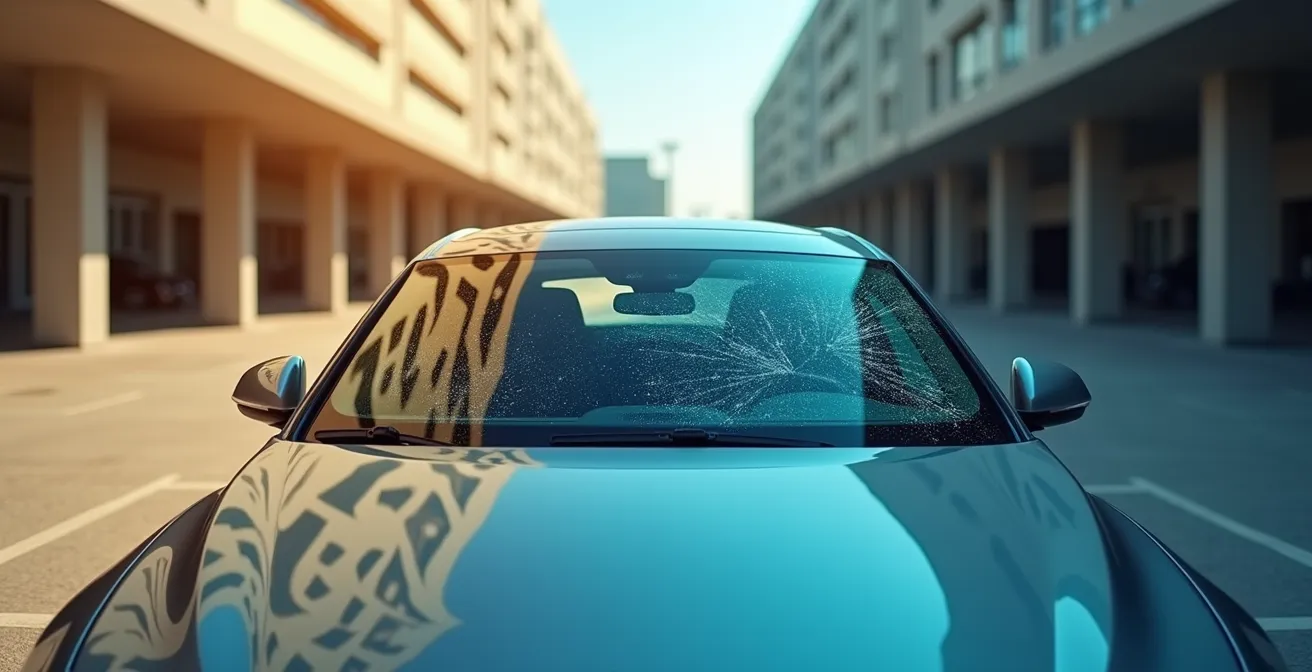
Common scenarios that trigger thermal shock include using the hot defroster on a frosty morning, washing a sun-baked car with cold water, or even driving from a cool garage into the hot summer sun. What was a simple, zero-deductible repair just moments before is now a mandatory replacement costing hundreds or even thousands of dollars. Contaminants like dirt and moisture can also work their way into an unsealed chip over time, making a successful repair impossible even if the crack doesn’t spread.
For this reason, the advice from any technician is unequivocal: repair a chip immediately. Don’t wait until the end of the week or for the weather to change. A 30-minute repair appointment is your only window to lock in the low-cost, no-deductible solution and prevent the inevitable, costly failure caused by thermal shock.
Why a Falling Tree Branch is Only Covered Under Comprehensive Plans?
When your windshield is damaged, the type of insurance coverage that applies depends entirely on the cause of the damage. This is a common point of confusion. The two primary types of physical damage coverage are Collision and Comprehensive. Collision coverage, as the name implies, pays for damage to your vehicle resulting from a collision with another object, such as another car or a stationary pole.
Comprehensive coverage, on the other hand, is for almost everything else. It covers damage from events that are not a collision. This includes theft, vandalism, fire, hitting an animal, and damage from weather or falling objects. As Progressive Insurance clarifies, “If your windshield is damaged due to falling debris, hitting an animal, or other unexpected events, then comprehensive coverage may cover the cost to repair or replace it minus your deductible.”
Therefore, if a tree branch falls on your car and cracks the windshield, it is a comprehensive claim, not a collision claim. The same applies to damage from hail, rocks kicked up by another vehicle on the highway, or an act of vandalism. Understanding this distinction is vital, as liability-only policies do not include comprehensive coverage, meaning you would have no coverage for such an event. You must have comprehensive coverage on your policy for your insurer to pay for the repair or replacement.
The following table, based on common insurance scenarios, helps clarify which policy applies in different situations.
| Damage Cause | Coverage Type | Example |
|---|---|---|
| Hit stationary object | Collision | Backing into pole |
| Natural events | Comprehensive | Falling tree branch |
| Animal strike | Comprehensive | Deer collision |
| Vandalism | Comprehensive | Intentional damage |
| Weather damage | Comprehensive | Hail, flooding |
Key Takeaways
- A “free” chip repair is a loss-prevention strategy for insurers; it’s far cheaper than a full replacement.
- Modern windshield replacement costs are high due to mandatory recalibration of ADAS safety sensors, which can add over $600 to the bill.
- Act immediately on any chip to prevent it from cracking due to thermal shock, locking in the low-cost repair and avoiding a costly replacement.
How to Add Glass Coverage to a Third-Party Policy for Under $5/Month?
Many drivers assume that their standard policy will automatically fix a windshield with no questions asked and no money out of pocket. In reality, a zero-deductible outcome is usually the result of a specific policy add-on called a “Full Glass Coverage” or “Zero-Deductible Glass” endorsement. This is not typically included in a standard third-party or even a basic comprehensive plan; it must be explicitly added.
The prerequisite for this endorsement is having comprehensive coverage already on your policy. Once you have that, you can request to add the full glass option. This add-on either eliminates your comprehensive deductible for glass-only claims or reduces it to a much smaller amount, like $50 or $100. The cost for this endorsement is surprisingly low, often ranging from $5 to $10 per month.
Considering the annual average cost of car insurance for full coverage is $1,674 per year in the United States, an extra $60 per year for the endorsement is a small price for significant peace of mind. It can save you from paying a $500 or $1,000 comprehensive deductible on a full windshield replacement. In some states, like Florida, Kentucky, and South Carolina, laws even require insurers to waive the deductible for windshield replacement if you have comprehensive coverage, making this benefit automatic for drivers in those locations.
To add this coverage, you simply need to contact your insurance agent or company and request the endorsement. It’s a straightforward process that involves verifying you have comprehensive coverage and then selecting the glass deductible option that works best for you. For any commuter who spends significant time on highways where rock chips are common, this small monthly investment offers an excellent return.
How a Simple Windshield Replacement Can Cost $1,000 Due to Sensors?
We’ve established that the ADAS sensors are the primary driver of high replacement costs, but the technical reality of the calibration process itself warrants a closer look. This isn’t a simple “plug and play” situation. A technician cannot just install a new windshield and assume the safety systems will work. The vehicle’s onboard computer must be told exactly where the new camera is looking, down to a fraction of a degree.
A failed or skipped calibration is a major safety liability. A camera that is off by a single degree could misjudge the distance of a vehicle ahead, causing the automatic emergency braking system to engage too late or not at all. It could cause the lane-keeping assist to steer the car out of its lane instead of into its center. The risks are not theoretical; they are a direct threat to you and other drivers on the road. This is why vehicle manufacturers are so strict about the procedures.
Furthermore, the process is fraught with potential failures that add time and cost. If an installer uses a lower-quality aftermarket windshield, its slight optical distortions may make it impossible for the camera to calibrate successfully. The technician would then have to remove the new, un-calibratable glass and start over with a higher-quality OEM windshield, effectively doubling the labor and material cost. This is a common scenario that quickly pushes a bill past the $1,000 mark. The high cost, therefore, is not just for the 30-minute procedure itself, but also an insurance against the liability of a failed safety system and the risk of rework.
Now that you understand the technical and financial stakes, the next logical step is to have any windshield damage, no matter how small, professionally assessed. Don’t wait for a small chip to become a major expense and a serious safety liability.
Frequently Asked Questions on Windshield Glass and Insurance
What’s the difference between OEM and aftermarket windshield glass?
OEM (Original Equipment Manufacturer) glass is made by the vehicle’s original manufacturer to exact specifications for fit, tint, and optical clarity. Aftermarket glass is produced by a third-party company. While it must meet federal safety standards, it may have slight variations in thickness, optical quality, and UV transmission rates that can potentially interfere with the proper function of ADAS sensors.
Can I request OEM glass from my insurer?
Yes, you can always request OEM glass for a replacement. However, a standard insurance policy typically only covers the cost of an aftermarket equivalent. To have the full cost of OEM glass covered, you may need a specific “OEM endorsement” on your policy or be prepared to pay the price difference between the aftermarket and OEM parts out of pocket.
How do I negotiate for OEM glass coverage?
The most effective way to negotiate for OEM glass coverage is to focus on safety, not brand preference. Reference your vehicle manufacturer’s specific position statements or Technical Service Bulletins (TSBs), which often mandate the use of OEM parts to guarantee the proper function of ADAS safety systems. Using the manufacturer’s own safety requirements as your primary argument provides a strong lever in your negotiation with the insurer.