
Comprehensive coverage is not an optional add-on; it is the financial firewall that prevents a single non-collision event from turning into a multi-thousand-dollar disaster.
- It covers high-cost incidents outside your control, such as storm damage, vandalism, or animal collisions, which are not covered by liability or collision policies.
- It addresses critical “hidden liabilities” like the gap between your car’s value and your loan balance after a total loss.
Recommendation: For any new, leased, or financed vehicle, pairing comprehensive with gap insurance is the only way to achieve complete financial protection and peace of mind.
For the discerning owner of a new, leased, or financed vehicle, the monthly insurance premium is a calculated investment. While liability and collision coverage are non-negotiable standards, comprehensive coverage is often viewed as an optional expense. This perspective, however, overlooks its fundamental purpose: to serve as a financial firewall against a host of unpredictable, high-cost events that have nothing to do with a typical car accident. These are the incidents that can trigger a catastrophic cost cascade, where one moment of misfortune leads to thousands in unexpected bills.
The true value of comprehensive insurance isn’t found in its day-to-day utility, but in its power to neutralize a major financial threat in a single stroke. It’s the coverage that protects your asset from theft, vandalism, fire, animal strikes, and “acts of God” like falling trees or floods. For owners who cannot afford significant, unplanned repair bills, understanding these specific scenarios is not just an academic exercise; it is the key to appreciating why this coverage is an essential component of responsible vehicle ownership. This guide deconstructs those critical moments where a comprehensive claim doesn’t just cover a repair—it preserves your financial stability.
To fully grasp how this protection applies in the real world, this article will explore several specific, high-stakes scenarios. The following sections break down exactly when and why comprehensive coverage becomes the most valuable part of your auto policy.
Summary: Why Comprehensive Coverage is an Essential Investment
- Why a Falling Tree Branch is Only Covered Under Comprehensive Plans?
- How Comprehensive Coverage Protects You When the Other Driver Flees?
- Collision vs. Comprehensive: Which One Covers Hitting a Deer?
- The ‘Gap Insurance’ Oversight That Leaves Leaseholders in Debt After a Crash?
- When is it Worth Claiming a Key Scratch Under Comprehensive Coverage?
- Why Insurers Waive the Deductible for Chip Repairs but Not Replacements?
- Why Your $30/Day Rental Limit Won’t Get You a Minivan for the Kids?
- The ‘Gap Insurance’ Oversight That Leaves Leaseholders in Debt After a Crash?
Why a Falling Tree Branch is Only Covered Under Comprehensive Plans?
A sudden storm, a gust of wind, or the simple effect of age can bring a heavy branch crashing down onto your vehicle. This scenario is a classic example of an “Act of God”—an event completely outside of your control. Liability insurance covers damage you cause to others, and collision insurance covers damage from hitting another object or vehicle. Neither applies here. This is the exclusive domain of comprehensive coverage.
Without it, the owner is solely responsible for repairs that can easily run into thousands of dollars, from a shattered windshield and dented roof to severe structural damage. For a high-value or new car, this single event could represent a devastating out-of-pocket expense. Comprehensive coverage transforms this potential financial disaster into a manageable inconvenience, requiring only that you pay your deductible.
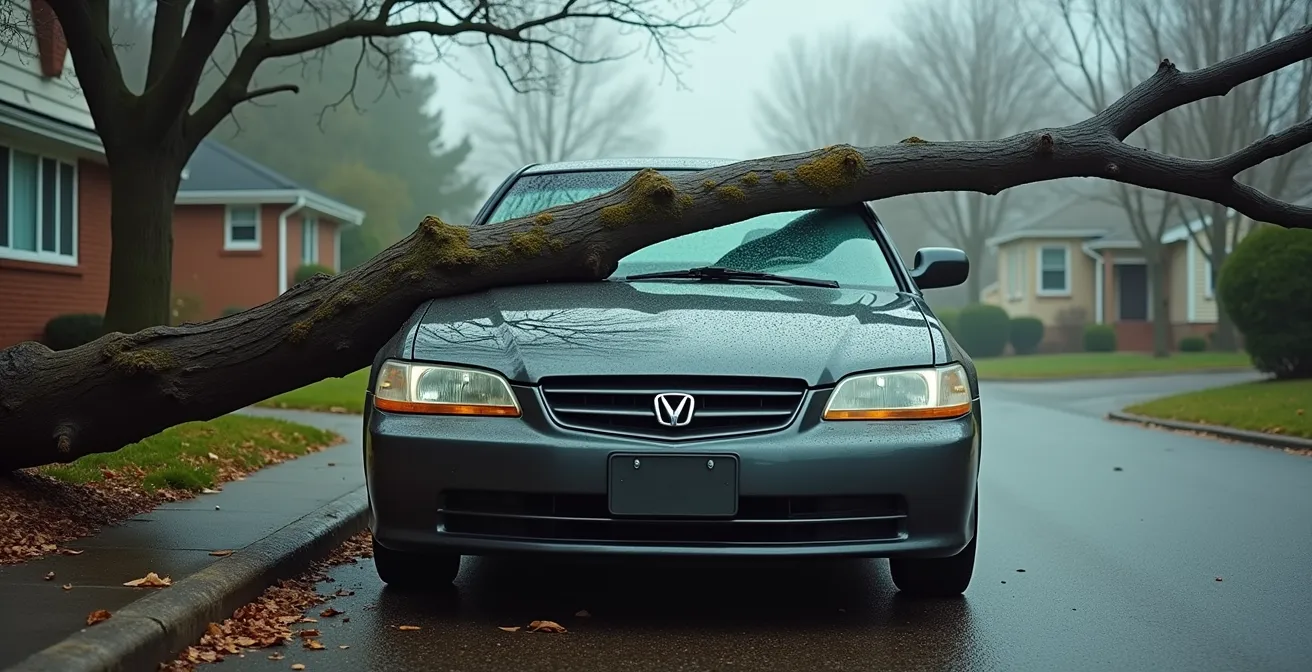
This coverage is designed precisely for these non-driving-related incidents. It protects the physical value of your vehicle—your value-at-risk—from a wide array of threats that have nothing to do with your skill as a driver. It provides certainty in an uncertain world, ensuring that your investment is protected whether it’s parked in your driveway or on the street.
Action Plan: After a Tree Falls on Your Car
- Assess Safety: Before approaching, ensure no power lines are involved. If safe, move the vehicle only if it doesn’t risk further damage. Activate your hazard lights.
- Document Everything: Take extensive photos from every angle, capturing the branch, the damage to your car, and the surrounding area. This visual evidence is crucial for your claim.
- Contact Your Insurer: Report the incident and file your comprehensive claim immediately. Your agent will guide you through the specific next steps.
- Do Not Assume Drivability: Even if the car starts, check for leaking fluids, tire damage, broken lights, or loose parts that could make it unsafe to operate.
- Arrange for Inspection: Your insurance company will need to have an adjuster inspect the damage to assess the cost of repairs before you proceed.
How Comprehensive Coverage Protects You When the Other Driver Flees?
Returning to your car in a parking lot to find a significant dent or scrape—with no note and no witness—is a deeply frustrating experience. This is a hit-and-run. While you might assume your collision coverage would apply, the situation is more complex. Many states classify damage to a parked, unoccupied vehicle by an unknown party as a comprehensive claim. Even if it’s treated as a collision claim, the at-fault driver is gone, leaving you in a difficult position.
Comprehensive coverage offers a direct and efficient path to resolution. It allows you to file a claim immediately without needing to identify the at-fault driver or wait for a potentially fruitless police investigation. This is a key benefit, providing peace of mind and faster repairs. For many owners, especially those with busy lives, avoiding this administrative burden is a significant part of the coverage’s value. The risk is more common than many think; a State Farm survey reveals that 40% of Millennials surveyed either didn’t have comprehensive coverage or weren’t sure if they did, leaving them exposed.
In essence, your comprehensive policy acts as a safeguard against the irresponsibility of others. Instead of being penalized for being the victim of a hit-and-run, you can rely on your own policy to make your vehicle whole again, typically after paying your deductible. It insulates you from the financial consequences of an event you played no part in, reinforcing its role as a financial firewall.
Collision vs. Comprehensive: Which One Covers Hitting a Deer?
An encounter with an animal on the road is sudden, dangerous, and surprisingly common. Insurers see millions of these claims annually. In fact, State Farm’s latest data shows nearly 1.7 million animal collision insurance claims were filed in the U.S. between July 2022 and June 2023. A frequent point of confusion for drivers is which policy covers the damage. The answer is almost always comprehensive coverage.
Hitting a live animal, such as a deer that runs into your path, is considered a non-collision event, akin to a falling object. It falls under comprehensive because the animal’s action is the proximate cause of the damage. However, the distinction is subtle and critical. If you swerve to *avoid* the deer and hit a tree or a guardrail instead, the resulting damage is covered by collision insurance, because your action of swerving led to the collision. This nuance can have significant implications for your deductible and claims history.
Understanding these specific scenarios is vital for any vehicle owner, as the financial outcomes are vastly different. The following breakdown clarifies which policy applies under various circumstances.
This table, based on common insurance industry standards outlined in a recent analysis of animal collision claims, illustrates the crucial differences.
| Scenario | Coverage Type | Reason |
|---|---|---|
| Hitting a deer that runs onto the road | Comprehensive | Considered an event outside the driver’s control (animal-initiated). |
| Swerving to avoid a deer and hitting a tree | Collision | Driver’s action (swerving) resulted in the collision with a fixed object. |
| A deer jumps and runs into the side of your vehicle | Comprehensive | Animal initiated the contact, not the driver. |
| Hitting a deer that is already dead on the road | Collision | Considered a collision with an avoidable road hazard or obstacle. |
The ‘Gap Insurance’ Oversight That Leaves Leaseholders in Debt After a Crash?
Perhaps the most significant “hidden liability” for owners of financed or leased vehicles is the gap between the car’s Actual Cash Value (ACV) and the remaining loan balance. If your car is totaled in an event covered by comprehensive insurance (like a flood or theft), your policy will pay out the vehicle’s current market value. However, due to depreciation, this amount is often thousands of dollars less than what you still owe your lender.
This shortfall is known as the “gap,” and you are legally responsible for paying it. Imagine your one-year-old SUV, with a $30,000 loan balance, is totaled in a flash flood. The insurance company determines its ACV is only $24,000. Without additional protection, you are handed a check for $24,000 to give to the lender, but you still owe them $6,000 for a car that no longer exists. This is a real-world scenario that illustrates the critical need for Gap Insurance.
Gap insurance is a separate policy designed specifically to cover this difference. It works in tandem with your comprehensive coverage to ensure a total loss doesn’t become a personal financial crisis. As one analysis of coverage guidelines notes, the two are an essential pair.
Comprehensive and Gap insurance are a mandatory duo for any financed or leased vehicle – one without the other leaves a massive financial hole.
– Insurance Industry Analysis, Auto Insurance Coverage Guidelines 2024
When is it Worth Claiming a Key Scratch Under Comprehensive Coverage?
Vandalism, such as an intentional key scratch along the side of your car, is another event covered exclusively by comprehensive insurance. While less catastrophic than a total loss, the repair can be surprisingly expensive, often involving sanding, priming, and blending new paint across multiple panels to achieve a seamless finish. The question for many owners is whether filing a claim is the right financial decision.
The answer depends on a simple calculation: is the repair cost significantly higher than your deductible? If your comprehensive deductible is $1,000 and the repair estimate is $1,200, filing a claim to save $200 may not be worthwhile, as a claim on your record could potentially lead to a minor premium increase over the next few years. However, if the vandalism is extensive and the repair cost is $3,000, filing the claim is almost certainly the correct choice.
A general guideline many use is the 10% rule. As a recommendation from insurance experts suggests, you might consider dropping comprehensive coverage altogether only when your annual premium for it exceeds 10% of your vehicle’s total value. For any car above that threshold, especially a newer one, keeping the coverage for major and minor events makes financial sense. Before filing for vandalism, it’s wise to consider the following points:
- Total Repair Cost: Get a professional estimate that includes multi-coat paint blending.
- Deductible Amount: Compare the repair cost directly to your deductible.
- Potential Premium Increase: Ask your agent about the impact of a vandalism claim.
- Claim Forgiveness: Check if your policy includes an endorsement that forgives your first claim.
Why Insurers Waive the Deductible for Chip Repairs but Not Replacements?
A small rock kicked up by a truck on the highway can create a chip or crack in your windshield in an instant. This is another classic comprehensive claim. Most insurers have a policy that seems counterintuitive at first: they will often waive your deductible entirely for a minor chip repair but require you to pay it for a full windshield replacement. The logic behind this is purely economic.
A chip repair is fast, inexpensive (typically under $100), and, most importantly, it prevents the chip from spreading and requiring a far more costly replacement. By incentivizing immediate repairs, insurers save themselves a much larger payout down the road. This is especially true for modern vehicles equipped with Advanced Driver-Assistance Systems (ADAS). Cameras and sensors for features like lane-keeping assist and automatic braking are often mounted to the windshield. Replacing the glass is no longer a simple swap; it requires a complex recalibration of these safety systems.
This recalibration is a specialized service that adds significant cost. According to industry data, professional ADAS calibration services can cost between $300 to $600, in addition to the price of the glass itself. A full replacement on a newer luxury vehicle can easily exceed $1,000. Faced with this reality, waiving a deductible for a minor repair becomes a clear win-win for both the driver and the insurance company.
Why Your $30/Day Rental Limit Won’t Get You a Minivan for the Kids?
When your car is in the shop following a comprehensive claim, rental reimbursement coverage is a vital lifeline. However, a common oversight is failing to secure a coverage level that matches your actual needs. A basic policy might offer a limit of $30 per day, which may be sufficient for a compact sedan. But if you drive a 7-seater SUV, that daily allowance will not cover a comparable rental, leaving you to pay the difference out of pocket.
This “hidden liability” is compounded by the potential duration of a repair. A straightforward collision repair might take a week, but as claims experts note, a comprehensive claim for flood or fire damage can take weeks or even months due to detailed assessments, parts backorders, and specialized labor. If your $30/day policy has a 30-day maximum, you could exhaust your $900 total benefit long before your vehicle is ready.
For owners of larger or higher-value vehicles, opting for a higher rental reimbursement limit (e.g., $50 or $75 per day) is a small additional premium that provides significant peace of mind. It ensures your lifestyle is not disrupted while your primary vehicle is being restored. The disparity between basic coverage and real-world costs is stark.
The following table, using data from a MoneyGeek analysis of rental reimbursement tiers, highlights the potential daily shortfall for a large family vehicle.
| Coverage Level | Daily Limit | Max Duration | Total Coverage | Actual 7-Seater SUV Cost/Day |
|---|---|---|---|---|
| Basic | $30 | 30 days | $900 | $85-$120 |
| Standard | $50 | 30 days | $1,500 | $85-$120 |
| Premium | $75 | 30 days | $2,250 | $85-$120 |
| Like-for-Like | Actual Cost | 30 days | Variable | Covered |
Key Takeaways
- Comprehensive coverage is your only protection against “non-collision” events like theft, vandalism, weather, and animal strikes.
- For financed or leased cars, comprehensive coverage is the prerequisite for Gap insurance, which protects you from owing money on a totaled vehicle.
- The “hidden costs” of claims, such as ADAS recalibration and inadequate rental reimbursement, make robust comprehensive coverage more valuable than ever.
The ‘Gap Insurance’ Oversight That Leaves Leaseholders in Debt After a Crash?
Throughout these scenarios, a clear pattern emerges: comprehensive coverage acts as the first line of defense against unexpected and often severe financial loss. From the dramatic impact of a falling tree to the subtle but significant cost of an ADAS recalibration, this single policy feature stands between you and a catastrophic out-of-pocket expense. It is the mechanism that ensures the value of your asset is protected from forces entirely beyond your control.
However, the ultimate expression of this financial security is realized when comprehensive coverage is paired with Gap insurance. For any driver with a loan or lease, this combination is not a luxury; it is a necessity. It closes the final, critical loophole that can leave you in debt long after your vehicle is gone. Together, they create a complete financial firewall, offering true peace of mind.
By investing in this level of protection, you are purchasing certainty. You are ensuring that one unfortunate event—whether it’s a deer on a dark road or a flood in your driveway—does not derail your financial future. This is how comprehensive coverage truly pays for itself, not just by covering a claim, but by underwriting your stability.
To ensure your policy provides this level of complete protection, the next logical step is to have your current coverage reviewed by a specialist who can identify any potential gaps in your financial armor.