
A critical machinery failure is not just an operational problem; it’s a test of your insurance contract’s real-world value, which is often lost in misunderstood clauses.
- Most claim denials stem from “contractual blind spots” like maintenance exclusions, not the failure event itself.
- Rapid recovery depends on your ability to provide concrete “operational proof” of loss, maintenance history, and hypothetical income.
Recommendation: Shift from passively holding a policy to actively managing it as a technical asset, with documentation protocols that pre-empt an adjuster’s questions.
When a critical piece of machinery grinds to a halt, the immediate focus is on repair and replacement. The secondary, and often more painful, process is navigating the equipment breakdown insurance claim. For many manufacturers and tech-dependent businesses, this is where the real friction occurs. The expectation of a straightforward payout collides with the reality of policy exclusions, depreciation clauses, and demands for extensive documentation. Standard advice often revolves around having a business continuity plan or simply “doing regular maintenance,” but this overlooks the granular, technical details that determine whether a claim is approved quickly or denied outright.
The core issue isn’t a lack of preparedness, but a misunderstanding of what insurance truly covers and what it contractually requires from you. It’s a system filled with contractual blind spots—from the nuances of rust and corrosion coverage to the critical difference between hardware failure and software data loss. Simply having a policy is not a strategy. The ability to resume operations swiftly is directly tied to your capacity to provide undeniable operational proof for every facet of your claim.
But what if the key wasn’t just in the policy document, but in the operational procedures you establish long before a failure ever occurs? This guide moves beyond generic advice. It delves into the technical realities of equipment breakdown claims, exposing the common pitfalls that lead to denials and delays. We will dissect the specific clauses that trip up most businesses and provide a strategic framework for documenting your assets, maintenance, and losses in a way that satisfies even the most scrupulous adjuster. This is your operational manual for turning an insurance policy from a piece of paper into a functional tool for rapid recovery.
This article provides a detailed roadmap for mastering the claims process. It breaks down the most challenging aspects of equipment breakdown coverage, offering technical insights and actionable strategies to protect your assets and accelerate your return to full operation.
Summary: Your Guide to a Rapid Operational Restart After Critical Machinery Failure
- Why Rust and Corrosion Are Never Covered by Breakdown Insurance?
- The Refrigerator Breakdown: How to Claim for $50k of Spoiled Stock?
- Actual Cash Value vs. Replacement Cost: Why Old Machines Need New Coverage?
- Hardware vs. Software: Does Equipment Insurance Cover the Data Inside?
- How to Pay for a Rental Generator While Yours Is Being Repaired?
- Why Your Insurer Might Deny a Claim Due to ‘Lack of Maintenance’?
- Why a Restaurant Needs Different Coverage Than a Consulting Firm?
- How to Prove Your ‘Hypothetical’ Income Loss to an Adjuster?
Why Rust and Corrosion Are Never Covered by Breakdown Insurance?
One of the most common and frustrating “contractual blind spots” for businesses is the exclusion of rust and corrosion from equipment breakdown coverage. The logic from an insurer’s perspective is straightforward: equipment breakdown insurance is designed to cover sudden and accidental failures, not gradual deterioration. Rust is seen as a maintenance issue—a failure to protect the asset from predictable environmental factors. Most standard and extended warranty contracts explicitly list corrosion as an exclusion, defining it as a form of contamination or wear and tear rather than an insurable event.
This distinction is critical. If a pump seizes due to a sudden electrical surge, it’s a clear breakdown. If the same pump fails because its housing has rusted through over several years, the claim will almost certainly be denied. The insurer will argue that proper, documented maintenance, including cleaning, painting, and environmental controls, could have prevented the loss. This places the onus of proof squarely on the business owner to demonstrate that the failure was not a result of neglect.
However, a strategic approach exists through the concept of “resulting damage.” While the rust itself isn’t covered, if a rusted part suddenly breaks and causes a separate, catastrophic failure in a different component (like a snapped bracket damaging a motor), that resulting damage may be covered. For example, if a car is submerged in a flood (a covered event), any rust that appears weeks later as a direct consequence could be included in the comprehensive claim for the flood. The key is to document a clear chain of causation linking the gradual issue to a sudden, covered peril. Proving this requires meticulous documentation and framing the claim around the consequential, not the initial, failure.
The Refrigerator Breakdown: How to Claim for $50k of Spoiled Stock?
For a restaurant, food distributor, or medical clinic, a refrigerator or freezer breakdown is a financial catastrophe. The loss extends far beyond the cost of repairing the unit; it’s the tens of thousands of dollars in spoiled inventory that represents the real threat. Claiming this loss successfully requires a level of operational proof that goes far beyond a simple repair invoice. The stakes are incredibly high; research from the National Institutes of Health reveals a single incident of food-borne illness can cost a restaurant over $2 million in various damages.
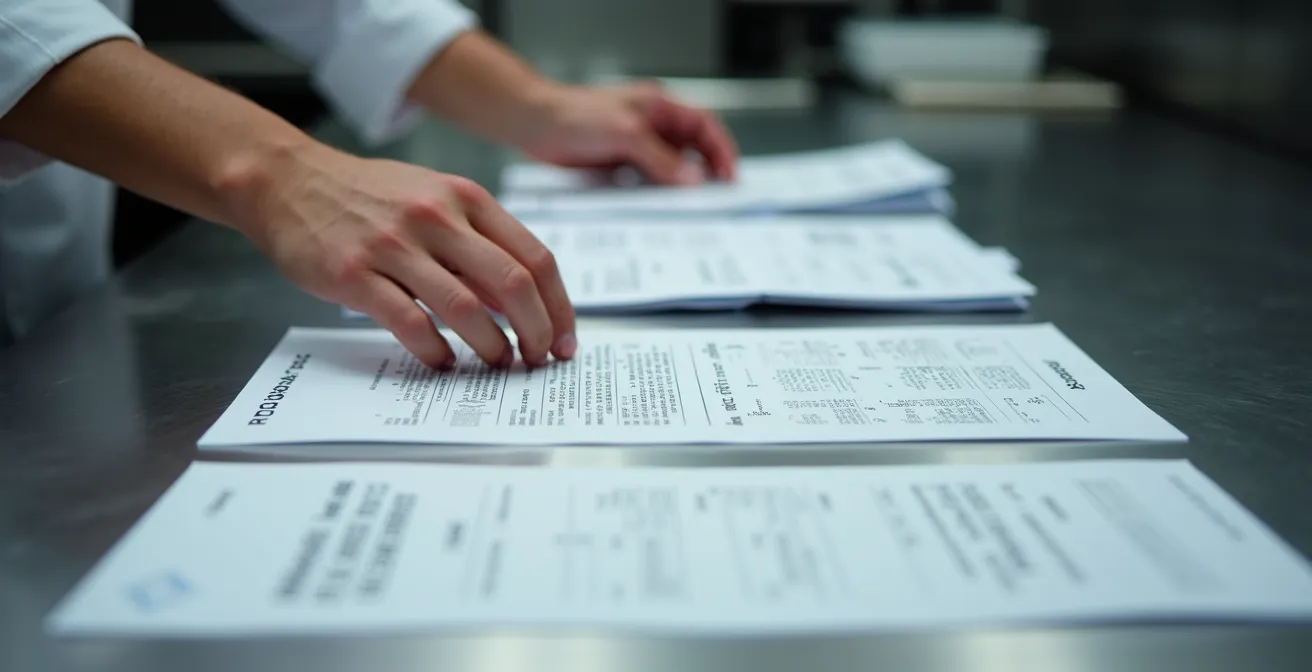
As the image above illustrates, the moment a breakdown is discovered, the response must be immediate and methodical. Your insurer will demand a comprehensive and verifiable inventory of every lost item. This includes not just a list, but supplier invoices to prove cost, batch numbers, and production dates. You must also provide temperature logs from before, during, and after the failure to prove the stock was held at a safe temperature and that the breakdown directly caused the spoilage. Photographs and videos of the spoiled goods before disposal are non-negotiable. An adjuster needs to see that you have done everything possible to mitigate the loss and that your claim is based on hard data, not estimates.
Furthermore, coverage for spoilage is not always standard and often comes with specific limits that vary dramatically by policy type. Understanding these sub-limits is essential for managing risk.
| Policy Type | Standard Coverage Limit | Enhanced Coverage Option |
|---|---|---|
| Homeowners Insurance | $500 | up to $2,500 or more |
| Equipment Breakdown Addition | $500 or $1,000 | $10,000 for food spoilage caused by power interruption or mechanical failure |
| Commercial Property | Varies | Usually covers about 45% of NEXT’s most common restaurant claims |
This data, highlighted in a comparative analysis by Policygenius, shows that a standard endorsement may be insufficient for a commercial operation. Without the right coverage and meticulous documentation, a $50,000 loss can easily become a $40,000-plus out-of-pocket expense.
Actual Cash Value vs. Replacement Cost: Why Old Machines Need New Coverage?
One of the most financially devastating “contractual blind spots” in equipment insurance is the distinction between Actual Cash Value (ACV) and Replacement Cost (RC) coverage. ACV reimburses you for the value of your failed equipment at the time of the loss, which includes a deduction for depreciation. Replacement Cost, on the other hand, covers the cost of replacing the old machine with a new, comparable model. For businesses relying on aging but functional machinery, an ACV policy can be a ticket to financial ruin.
Imagine a 10-year-old CNC machine, critical to your production line, fails catastrophically. Its ACV might be just $15,000 due to depreciation. However, a new equivalent machine costs $150,000. An ACV policy would leave you with a $135,000 shortfall, severely impeding your ability to resume operations. This is why understanding your asset lifecycle coverage is paramount. As equipment ages, the financial risk of an ACV policy grows exponentially. It becomes a form of underinsurance that only reveals itself at the worst possible moment. The cost of downtime makes this even more critical.
The average business experiences equipment downtime that costs between $5,600 to $9,000 per minute.
– Andrew Harris, CIC and AAI, Liberty Insurance Equipment Breakdown Guide 2025
The problem is compounded by the primary causes of equipment failure. According to TÜV SÜD’s risk engineering analysis, equipment breakdown now rivals fire in claim frequency, with a staggering three-quarters of equipment losses attributed to a lack of maintenance. An insurer will argue that an older, poorly maintained machine has a lower ACV and a higher risk of failure, justifying a smaller payout. Upgrading to an RC policy for critical, aging assets is not an expense; it’s a strategic investment in operational continuity.
Hardware vs. Software: Does Equipment Insurance Cover the Data Inside?
In the modern industrial landscape, the line between hardware and software is increasingly blurred. However, in the world of insurance, it’s a hard, bright line with significant financial implications. Equipment breakdown insurance is designed to cover the physical—the tangible components of your machinery. What it explicitly does not cover is the intangible: the software, data, and programming that make the hardware function. This is a critical distinction that many businesses overlook.
When a server, computer-controlled lathe, or automated packaging system fails due to a power surge, the policy will cover the cost of repairing or replacing the damaged circuit boards, motors, and processors. It will not cover the cost of recovering lost production data, reinstalling custom firmware, or reprogramming the system. This gap can lead to extended downtime and substantial hidden costs. According to a guide from Munich Re, microelectronics have become the brains that drive equipment, making this vulnerability more acute than ever.
A standard equipment breakdown policy typically covers a range of physical assets, but the exclusion of software is universal:
- Mechanical equipment: Motors, engines, generators, elevators, and specialized production machinery.
- Electrical equipment: Transformers, electrical panels, and cables.
- Computers and communications: Computer systems, phone systems, and security or fire alarm systems.
Even though the computer hardware itself is covered, the policy documentation will specify that software is not. To protect the data and programming—often the most valuable part of the system—a separate cyber liability insurance policy is required. Relying solely on equipment breakdown coverage for modern, intelligent machinery is like insuring a car but not the driver’s ability to operate it. The physical asset may be restored, but its operational value remains zero without the software and data.
How to Pay for a Rental Generator While Yours Is Being Repaired?
When a primary power system or a critical piece of machinery fails, the immediate repair cost is only one part of the financial equation. The other is the cost to maintain partial or full operations while repairs are underway. This is where Expediting Expense coverage, an often-included but poorly understood component of equipment breakdown insurance, becomes vital. This coverage is designed to pay for the temporary measures needed to speed up recovery and mitigate further business interruption losses.
This can include paying for a temporary rental generator, leasing a replacement machine, or covering the overtime and air freight costs to get a critical part delivered faster. For instance, an office building that lost power due to destroyed electrical panels had to spend nearly $1.6 million to restore service to tenants—a cost potentially covered under expediting expenses. Similarly, a printer that spent over $136,000 on rush repairs for a high-speed press after a bolt jammed its gears could file a claim under this provision. These are not optional expenses; they are essential investments to reduce the far greater cost of prolonged downtime.
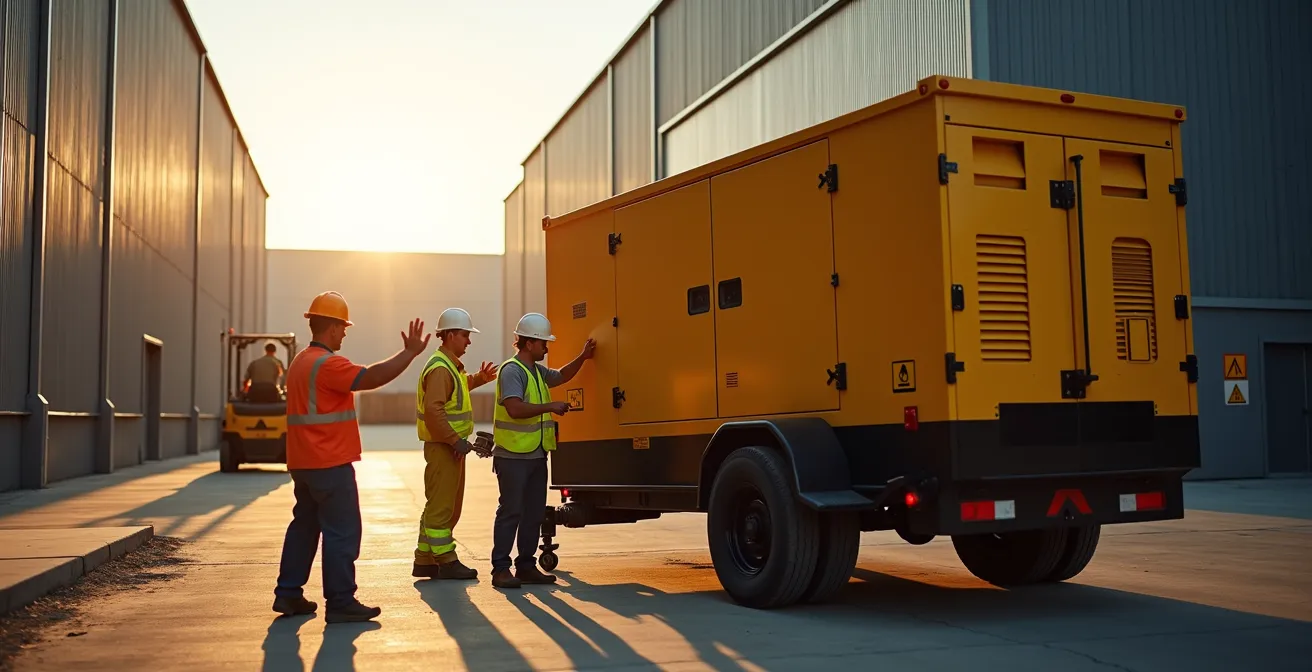
The key to leveraging this coverage is demonstrating to the insurer that the expediting expense is economically sound. You must prove that spending, for example, $10,000 on a rental generator will prevent $100,000 in lost revenue. This requires a solid hypothetical income justification. You need to present clear financial projections showing the income you would lose for every day you remain offline. By framing the rental as a cost-saving measure, you transform it from an additional expense into a necessary step to protect both your business and the insurer from a much larger business interruption claim.
Why Your Insurer Might Deny a Claim Due to ‘Lack of Maintenance’?
The “lack of maintenance” exclusion is the single most common reason for the denial of equipment breakdown claims. Insurers view their policies as protection against unforeseen accidents, not as a substitute for responsible asset management. If they can argue that a failure was caused or exacerbated by neglect, they have a contractual right to deny coverage. This makes your maintenance protocol and its documentation the most important element of your entire insurance strategy.
A policy is designed to cover internal malfunctions like power surges, motor burnout, or mechanical shorts. It is not intended to pay for damage resulting from failing to perform routine service, ignoring warning signs, or general wear and tear. The burden of proof falls entirely on you to demonstrate that the equipment was properly cared for. Without this operational proof, an adjuster can easily classify a failure as a maintenance issue, thereby voiding the claim.
So, how do you satisfy this requirement? Insurers may look for several key pieces of evidence. First and foremost is a service policy or maintenance agreement, especially for critical systems like refrigeration or HVAC. Many policies contain a clause stating that if you voluntarily terminate a service agreement without notifying the insurer, your coverage for that equipment is automatically suspended. Second, they will want to see detailed maintenance logs. These logs should record every service, inspection, and repair, including dates, technician notes, and parts replaced. This documented history is your best defense against a “lack of maintenance” denial, proving that you have acted responsibly to preserve the asset’s condition and prevent predictable failures.
Why a Restaurant Needs Different Coverage Than a Consulting Firm?
Not all business insurance is created equal. The type of equipment breakdown coverage a business needs is dictated entirely by its specific operational risks. A restaurant and a consulting firm may both generate the same annual revenue, but their vulnerabilities—and therefore their insurance needs—are worlds apart. A one-size-fits-all policy is a recipe for disaster, as it will inevitably leave critical gaps in coverage for one or both businesses.
The primary risk for a restaurant lies in its physical, perishable inventory and the specialized equipment required to store and prepare it. A power outage or a walk-in freezer malfunction can lead to tens of thousands of dollars in spoiled goods and bring business to a complete halt. Its coverage must prioritize spoilage and business interruption tied to mechanical failure. A consulting firm, on the other hand, faces a different threat. Its most critical assets are its data, servers, and communication systems. A hardware failure is problematic, but the real catastrophe would be the loss of client data or project files. Therefore, its risk management strategy must lean heavily towards cyber liability and data recovery, with equipment breakdown as a secondary concern.
This stark difference in risk profiles requires a tailored insurance approach, as a direct comparison makes clear.
An analysis of business-specific risks provides a clear framework for understanding these divergent needs.
| Risk Category | Restaurant | Consulting Firm |
|---|---|---|
| Primary Equipment | Refrigerator or walk-in freezer | Computers and servers |
| Main Coverage Need | Power outages, equipment failure, equipment contamination | Data loss, cyber liability |
| Typical Loss Event | $40,000-$200,000 worth of equipment in the kitchen alone | Data breach, system downtime |
| Business Interruption | Spoilage coverage reimburses businesses when power outages ruin perishable items. Business income coverage may apply. | Lost billable hours, project delays |
Choosing the right coverage is not about buying a product named “equipment breakdown insurance.” It’s about conducting a thorough risk analysis of your specific operations and building a policy that addresses your unique points of failure. For a restaurant, that’s spoilage; for a consultancy, it’s data.
Key Takeaways
- Claim success is determined by operational proof, not the failure event itself. Meticulous documentation of maintenance, inventory, and finances is non-negotiable.
- Insurance policies are filled with “contractual blind spots” like rust, wear and tear, and software data exclusions. You must know them before a failure occurs.
- Coverage must evolve with your assets. An Actual Cash Value (ACV) policy on aging critical equipment is a significant financial risk that requires upgrading to Replacement Cost (RC).
How to Prove Your ‘Hypothetical’ Income Loss to an Adjuster?
When a critical machine fails, the most difficult part of an insurance claim is often not proving the cost of the repair, but proving the income you lost while your operations were down. This is the core of a Business Interruption claim. You are asking the insurer to compensate you for money you *would have* earned. This requires a robust and credible hypothetical income justification, built on historical data and logical projections. An adjuster will not accept guesswork; they need to see a formula.
The process starts with establishing a baseline. You must provide detailed financial records from previous, comparable periods (e.g., the same month last year, the previous quarter). This includes profit and loss statements, sales records, and production reports. This data forms the foundation of your claim, showing what your business was earning under normal conditions. From there, you must project the income you lost during the downtime. This calculation should account for fixed operating costs that continued (rent, salaries) and variable costs that were saved (raw materials not used).
The goal is to present the adjuster with a clear, defensible narrative supported by documentation. You must demonstrate the direct link between the equipment failure and the drop in revenue. If your claim is transparent, professional, and backed by solid operational proof, your chances of a fair and prompt settlement increase dramatically. An adjuster’s job is to validate losses, and making their job easier is the fastest way to get your claim paid. To do this, a structured documentation process is essential.
Action Plan: Your Documentation Checklist for Business Interruption Claims
- Compile financial records: Gather historical profit and loss statements, sales reports, and tax returns to establish a pre-loss performance baseline.
- Document the event: Secure the completed claim form from your insurer and, if applicable, written confirmation from a utility company for outages or refrigeration maintenance reports for equipment malfunctions.
- Calculate the loss: Create a detailed projection of lost revenue based on historical data, factoring in both continuing fixed costs and saved variable costs.
- Maintain professionalism: Act transparently if an adjuster inspects your business and respond promptly to all communications and requests for additional documentation.
- Track all expenses: Keep meticulous records of all expediting expenses incurred to speed up recovery, such as rental equipment or rush shipping for parts.
Ultimately, navigating an equipment breakdown claim is a technical skill. To ensure your business is fully protected, the next logical step is to conduct a thorough audit of your current insurance policies and internal documentation procedures against the principles outlined in this guide. Identify your contractual blind spots and strengthen your operational proof now, before you need it.